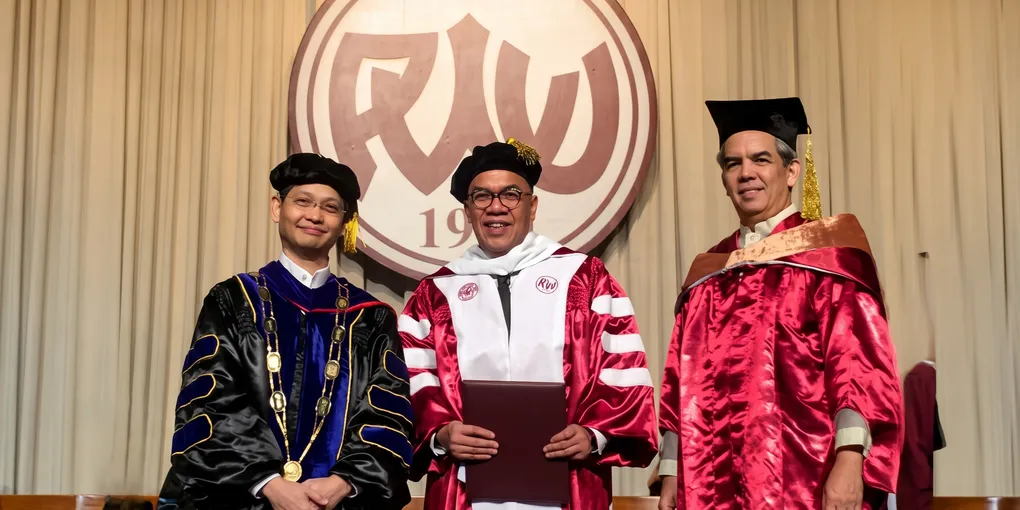
Boy Abunda's ETEEAP Story: How the King of Talk Shows Finally Earned His College Degree
Eugenio R. Abunda, Jr., the broadcaster the entire industry simply calls Boy Abunda, or the King of Talk Shows, was once just another college dropout with a story he rarely told in public. Today he is also the founding chairman of the Make Your Nanay Proud Foundation and Asian Artists Agency, but long before any of that, he left Ateneo de Manila University in the middle of his Business Management degree when his father died, and for years after that, work simply took over. There was no time to go back. There was no diploma either, no matter how many shows he hosted or how many careers he helped build along the way.
That changed quietly, then all at once, in the span of one grueling weekend. On a Sunday episode of The Buzz, Boy Abunda announced something his viewers did not see coming. He had finished his undergraduate degree in Communication Arts, and in the very same stretch of months, he had also wrapped up a term of his master’s studies, both through Philippine Women’s University. The man behind the announcement still sounded a little stunned by it himself.
Here is how the story unfolded, and what it tells us about the program that made it possible.
In This Story
- The Diploma He Never Picked Up
- Finding His Way Back Through Equivalency
- Doing Two Degrees at Once, Against the Rules
- The Weekend That Broke Him a Little
- He Did Not Want to Erase Ateneo
- The Theses That Nearly Did Him In
- From Master’s Degree to Doctor of Philosophy
- What Boy Abunda’s Story Means If You’re Thinking About ETEEAP Today
The Diploma He Never Picked Up
Boy Abunda was honest about it on air. He never graduated from college. His major was Business Management, a course his parents pushed him toward because they wanted a lawyer in the family. Then his father passed away, and the young Boy made a decision a lot of Filipinos have had to make at some point: he chose to work instead of finishing school.
Decades went by. He built an entire broadcasting career, became a household name, and mentored countless young talents, all without the piece of paper that, fairly or not, still opens doors in this country. By the time he sat down with the Philippine Entertainment Portal after that Buzz episode, he was ready to explain the “kalokahan,” as he put it, of pursuing two degrees at the same time just to finally close that chapter.
Finding His Way Back Through Equivalency
The year before his announcement, Boy Abunda enrolled in what was then known as the Expanded Tertiary Education Equivalency and Accreditation Program, the same alternative pathway that today operates under Republic Act No. 12124. He was, in fact, one of the very first graduates of PWU’s ETEEAP track, at a time when the program was still a relatively unfamiliar option for most Filipinos. Back when Boy went through it, the program ran on the strength of Executive Order No. 330, the original 1996 mandate that first allowed Filipinos to convert real-world experience into academic credit. The law that institutionalized the program permanently came years later, but the spirit of what he experienced was identical to what applicants go through now.
He explained it simply to PEP. The program looks closely at your work experience and figures out how much of it can be converted into academic units. In his case, there were still gaps. He had no units in Math. He never finished ROTC. Those were the kinds of holes that years of hosting talk shows and managing talents could not fill on their own, so the deputized school still required him to sit for additional subjects before it would consider his undergraduate requirements complete.
This is exactly the kind of process described in what ETEEAP actually does today, where a panel of assessors compares an applicant’s documented experience against the learning outcomes of a specific degree, then identifies what still needs to be completed through coursework, exams, or a portfolio defense. Boy’s case had all three.
Doing Two Degrees at Once, Against the Rules
Here is the part Boy Abunda himself flagged as unusual. While he was still finishing the requirements of his ETEEAP undergraduate degree, he had already begun taking units toward a master’s degree in International Relations on Public Diplomacy, also at PWU. He admitted outright that this was not really supposed to happen. Graduate study generally assumes a finished bachelor’s degree sitting underneath it.
He pushed through anyway, juggling both tracks at once. It made an already demanding process even harder, but it also meant that by the time he crossed one finish line, he was already deep into the next one. Today’s ETEEAP eligibility guidelines are built around a more orderly progression for a reason, but Boy’s experience is a reminder of just how determined an applicant has to be to make an unconventional academic path work.
The Weekend That Broke Him a Little
The most dramatic part of his story happened over the course of a single weekend. On a Saturday, Boy Abunda took his validating exams for Communication Arts. He submitted his undergraduate thesis. He even had his graduation photos taken in a toga that day, almost as a small act of faith that everything would fall into place. That same day, he also finished the second term of his master’s program and turned in the thesis for that as well.
He called it one of the hardest days of his life, and also one of the most fulfilling. A few days later, on April 4, he formally graduated from Philippine Women’s University, sharing the stage with fellow newsmaker Cory Quirino, who was also completing her own degree journey there. Boy himself was not even physically present at the ceremony. He was out of town when the moment he had worked toward for months finally arrived on paper.
He Did Not Want to Erase Ateneo
One detail Boy Abunda was careful to clarify was how much credit Ateneo de Manila deserved in all of this. Every academic unit he had ever earned there during his original Business Management years became part of the evidence that PWU evaluated for his equivalency. He specifically thanked the Ateneo Registrar’s Office for sending over his official records so the assessment could move forward.
This lines up with how equivalency actually works under the law. Under the ETEEAP framework, formal academic credit a candidate already earned, even from a different school and even decades earlier, can be folded into the assessment alongside non-formal and informal learning. It is not an either-or choice between your old school and your new one. Boy made a point of saying he did not want to deny his Ateneo roots even as he credited PWU for finally getting him across the finish line.
The Theses That Nearly Did Him In
If there was one thing Boy Abunda complained about more than anything else, it was the thesis work, and he had to write two of them in the same stretch of months. For his graduate program, he tackled a comparative study of environmental diplomacy across eight Asian countries, including the Philippines, looking at the strengths and weaknesses of each nation’s environmental policies. He used Singapore’s water dependency on Malaysia, and its eventual mastery of desalination technology, as one of his case studies.
His undergraduate thesis took a very different turn. He chose to examine how values were communicated to viewers through his long-running noontime show, Boy & Kris. It sounds like a lighter topic on paper, but he described it as surprisingly difficult to put together, joking that the final report ended up thicker than he expected.
Two theses, two very different subjects, finished within days of each other. It is not hard to see why he called it one of the toughest stretches of his life.
From Master’s Degree to Doctor of Philosophy
That weekend in 2009 was not the end of Boy Abunda’s academic story. It was closer to the middle. He carried the momentum from his ETEEAP-completed bachelor’s degree straight into his master’s program, and a few years after that, he enrolled in a Doctor of Philosophy in Social Development, once again at PWU.
He completed that doctorate too, eventually walking the stage at a PWU commencement to receive his PhD. His dissertation was titled “Mother-Nurtured Leadership,” a study that explored maternal love as a tool for raising transformational leaders. It is hard to miss how closely that theme tracks with his own life outside the classroom. As founding chairman of the Make Your Nanay Proud Foundation, Boy Abunda has spent years funding the education of children in honor of their mothers, and the dissertation feels like an academic extension of that same advocacy.
It is a fitting arc for a man who once had to leave school because his father died. He went on to earn three degrees from the same university, the last one built around a tribute to mothers.
What Boy Abunda’s Story Means If You’re Thinking About ETEEAP Today
Boy Abunda is far from the only public figure who has gone through this pathway. Communication Arts graduates like him have company on our Success Stories page, including actress Ruffa Gutierrez, who completed the same Communication Arts degree at the same university years later, and Matteo Guidicelli, who earned his marketing degree through a different deputized school entirely. Each of these stories looks different on the surface, but they share the same underlying idea, that years of real work can stand in for years spent in a lecture hall, as long as it gets properly assessed.
What stands out about Boy’s case in particular is how much effort it still demanded. ETEEAP was never meant to be a shortcut, and his account makes that obvious. Validating exams, a panel-reviewed thesis, additional coursework to cover his gaps in Math and ROTC, all of it had to be done properly before PWU would confer his degree. The program rewards experience, but it still asks for proof, structure, and discipline before it hands over that diploma.
If his story resonates with you, whether you are a working professional who left school early or someone who has spent years building a career without the credential to show for it, the same door is still open. You can check the current qualifications and document checklist, browse the list of CHED-deputized schools currently accepting ETEEAP applicants, or take the quick eligibility check to see where you stand. Boy Abunda spent months of late nights, validating exams, and back to back theses to finally hold that diploma. The road is not short, but as his story shows, it is very much walkable.