University of Luzon Convenes Plenary on ETEEAP and Micro-Credentialing, Signals a More Flexible Path to a Degree
Most academic conferences do not make it onto the radar of the average working professional. But every so often, a university plenary session lands on a topic that has real consequences for people outside the lecture hall, and this is one of those times.
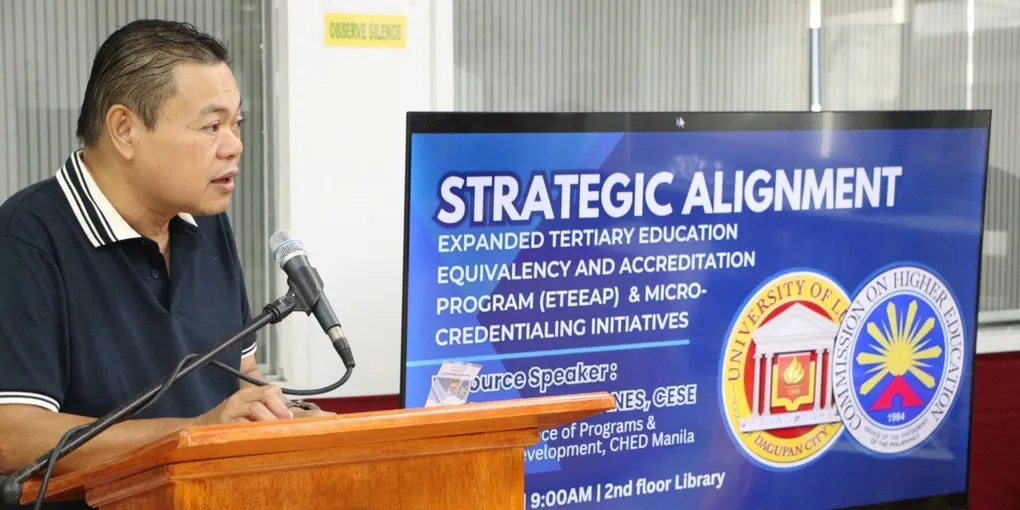
On May 8, 2026, the University of Luzon in Dagupan opened its 2nd Floor Library to academic leaders, administrators, faculty members, and stakeholders for a whole-day plenary session titled “Strategic Alignment: ETEEAP & Micro-Credentialing Initiatives.” At first glance it sounds like an internal planning meeting. Look closer, though, and it is really a conversation about how the university intends to widen the door for adult learners, career shifters, and professionals who built their expertise on the job rather than in a classroom.
Here is a quick jump to what this article covers:
- A Full Day Built Around One Question
- The Resource Speaker From OPSD
- Who Spoke and What They Committed To
- Why Micro-Credentials Keep Coming Up Alongside ETEEAP
- Learner-Centered Education and the Bigger Development Picture
- What This Could Mean for Future ETEEAP Applicants
A Full Day Built Around One Question
The plenary’s central question was straightforward enough: how does a university stay relevant to learners whose lives no longer fit the traditional four-year mold? University of Luzon framed its answer around two education reform tools that, on paper, look different but actually reinforce each other. One is the Expanded Tertiary Education Equivalency and Accreditation Program, the decades-old pathway that lets working adults convert prior learning and professional experience into a recognized degree. The other is micro-credentialing, a newer and more modular way of certifying specific skills.
Putting both on the same agenda was a deliberate choice. It signaled that the university is not treating these as separate initiatives running on parallel tracks, but as pieces of the same puzzle: giving people credit for what they actually know, in whatever form that knowledge was gained.
The Resource Speaker From OPSD
The plenary’s resource speaker was Dr. Jimmy Catanes, CESE, from the Office of Programs, Standards and Development. That office is not a minor detail here. Under the Implementing Rules and Regulations of Republic Act No. 12124, the law that institutionalized ETEEAP nationwide, the Office of Programs and Standards Development, or OPSD, serves as the permanent technical secretariat carrying out CHED’s powers and functions for the program. In other words, when someone from OPSD speaks about strengthening ETEEAP implementation, they are speaking from the office that effectively runs the program’s day-to-day machinery.
Dr. Catanes used the session to share insights on strengthening ETEEAP implementation and advancing micro-credentialing initiatives that recognize prior learning, professional experience, and industry-relevant skills. The framing matters. These are not presented as competing priorities but as two arms of the same push toward competency-based learning, professional education, and flexible pathways that respond to how the workforce is actually changing.
If you want to understand the legal backbone behind everything Dr. Catanes discussed, our guide to CHED CMO No. 11, Series of 2025: The New ETEEAP Rules Explained breaks down the implementing rules in plain language, section by section.
Who Spoke and What They Committed To
The program opened with welcome remarks from Prof. Tzarita Marie P. Mayo, Dean of the College of Medical Laboratory Science and Pharmacy, before turning to a series of institutional messages of support. Dr. Luis M. Samson, Jr., University President, spoke on behalf of the administration, followed by Dr. Aurora M. Samson-Reyna, Vice President for Academic Affairs, and Dr. Christine Nabor-Ferrer, Director IV of the International Affairs Service at CHED Manila.
Having the University President, the Vice President for Academic Affairs, and a CHED Director all deliver remarks at the same plenary is worth noting. It suggests the topic was treated as more than a routine faculty briefing. When top-level administrators and a CHED regional official share a program on ETEEAP and micro-credentialing, it usually means the institution is preparing to move, not just discuss.
Why Micro-Credentials Keep Coming Up Alongside ETEEAP
If you have been following ETEEAP news lately, you may have noticed micro-credentialing showing up more often in official conversations. There is a reason for that, and it is written directly into the rules governing the program.
The Implementing Rules and Regulations of RA 12124 explicitly address micro-credentials in the section covering competency enrichment programs. Deputized higher education institutions are encouraged to adopt flexible learning modalities to serve applicants with diverse educational backgrounds and learning needs. But the rules add an important condition: HEIs that plan to issue micro-credential certificates as part of their ETEEAP implementation must first obtain prior approval from the Commission, to make sure the credentials line up with national standards and recognition frameworks.
That single provision explains a lot about why University of Luzon paired these two topics in one plenary. Micro-credentials are not a shortcut around the ETEEAP process. They are a documentation tool that, when properly authorized, can help map an applicant’s non-formal and informal learning against the specific competencies a degree program requires. Done right, they make the portfolio-building side of ETEEAP more precise rather than less rigorous.
For a closer look at how the assessment side of ETEEAP actually works once an applicant reaches that stage, our explainer on the ETEEAP journey and how work experience becomes college credit walks through the portfolio, assessment, and enrichment stages in more detail.
Learner-Centered Education and the Bigger Development Picture
Much of the plenary’s discussion centered on learner-centered and active learning approaches, the kind of teaching philosophy that treats the student’s existing knowledge as a starting point rather than something to be overwritten. That framing lines up with what the ETEEAP Act itself set out to do. Republic Act No. 12124 was written to protect and promote the right of every citizen to accessible, quality education, and to build pathways that let people move fluidly between formal, non-formal, and informal learning systems and the labor market.
University of Luzon tied the session to three United Nations Sustainable Development Goals, and the connections are not a stretch once you look at what ETEEAP and micro-credentialing actually do. SDG 4, Quality Education, is served directly by expanding access to higher education and formally recognizing prior learning. SDG 8, Decent Work and Economic Growth, follows naturally once professionals gain credentials that improve employability and workforce readiness. And SDG 17, Partnerships for the Goals, shows up in the very structure of the event itself, a university, a national government agency, and a room full of academic stakeholders working through the same problem together.
It is a reminder that a plenary session in a university library in Pangasinan is, in its own modest way, connected to a much larger conversation about how the Philippines equips its workforce for a shifting economy.
What This Could Mean for Future ETEEAP Applicants
For working professionals watching from the outside, sessions like this are a useful signal, even before any new program or micro-credentialing offering is formally announced. It tells you that the university’s leadership, down to the President and Vice President for Academic Affairs, is actively engaging with how ETEEAP should evolve, rather than treating it as a program that runs quietly in the background.
If you are considering ETEEAP at University of Luzon or anywhere else, it is always worth confirming a school’s current deputization status and program offerings directly with its ETEEAP office, since authority to run the program is specific to each institution and each degree. Our accredited ETEEAP schools directory is a good starting point for comparing options across the country, and if you are not yet sure whether you meet the basic qualifications, our eligibility guide walks through the age, education, and work experience requirements in a few minutes.
Years of hard-won experience deserve more than a line on a resume. Whether it is through the traditional ETEEAP assessment process or the newer, CHED-approved micro-credentialing pathways institutions like University of Luzon are now exploring, there are more ways than ever to turn what you already know into a degree that says so. Ready to see where you stand? Check your eligibility or browse our full library of ETEEAP guides to plan your next move.
ETEEAP.PH is an independent guide. Always verify the latest program details directly with University of Luzon or your chosen deputized institution.
Photo credit: University of Luzon