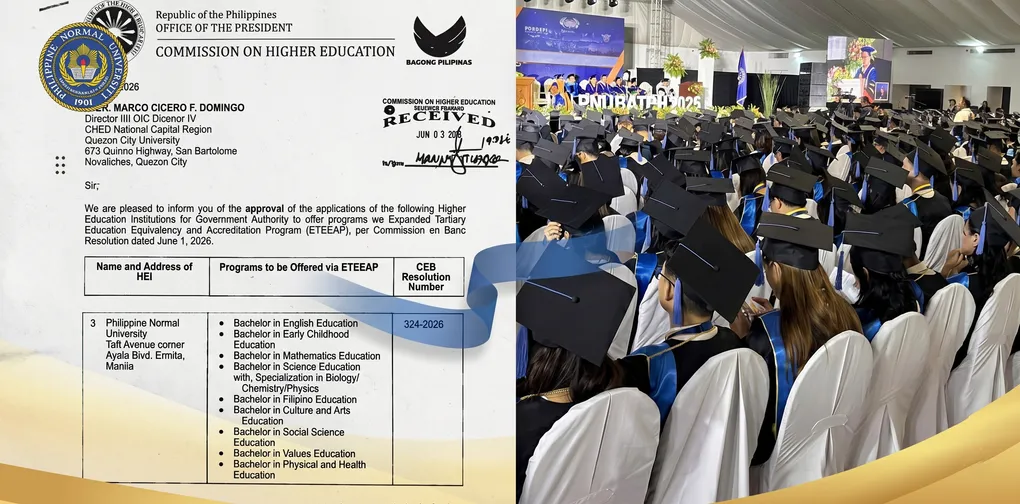
Philippine Normal University Gets CHED Approval to Offer 11 Education Degree Programs via ETEEAP
The Philippine Normal University (PNU), the country’s flagship teacher education institution, has officially joined the growing list of CHED-deputized providers of the Expanded Tertiary Education Equivalency and Accreditation Program. In early June 2026, the Commission on Higher Education formally authorized PNU to offer 11 undergraduate education degree programs through ETEEAP, marking a significant expansion of opportunities for working education practitioners who have long been without a path to formal academic credentials.
For tens of thousands of teaching aides, learning facilitators, day care workers, and subject specialists across the Philippines who have spent years in classrooms without a matching college diploma, this development is more than institutional news. It is a concrete opening.
In This Article
- The Official CHED Approval
- The Full List of PNU ETEEAP Programs
- Why PNU’s Inclusion Is Significant
- Who Can Apply at PNU via ETEEAP?
- What the Assessment Process Looks Like
- How to Reach PNU About ETEEAP
The Official CHED Approval
The approval was formalized through Commission en Banc (CEB) Resolution No. 324-2026, signed on June 1, 2026. The official communication was transmitted on June 3, 2026, through a 1st Indorsement addressed to PNU President Dr. Bert J. Tuga by the CHED National Capital Region office.
The resolution grants PNU Government Authority to operate its identified programs under the ETEEAP framework. Physical copies of the Government Authority certificates for the respective programs are expected to be issued in the coming weeks, and PNU has indicated that specific admission guidelines and assessment procedures for interested applicants will be announced in the coming months through its College of Alternative and Lifelong Learning.
This approval comes under the legal framework established by Republic Act No. 12124, also known as the ETEEAP Act, which was signed into law in March 2025 and institutionalized the program as a permanent pillar of the Philippine tertiary education system. The Implementing Rules and Regulations, issued as CHED Memorandum Order No. 11, Series of 2025, set the current standards governing how deputized institutions like PNU must conduct assessments and grant equivalency credits.
The Full List of PNU ETEEAP Programs
Under CEB Resolution No. 324-2026, PNU is authorized to offer the following 11 undergraduate programs through ETEEAP:
- Bachelor in English Education
- Bachelor in Early Childhood Education
- Bachelor in Mathematics Education
- Bachelor in Filipino Education
- Bachelor in Culture and Arts Education
- Bachelor in Social Science Education
- Bachelor in Values Education
- Bachelor in Physical and Health Education
- Bachelor in Science Education (major in Biology)
- Bachelor in Science Education (major in Chemistry)
- Bachelor in Science Education (major in Physics)
The coverage is broad and intentional. From early childhood practitioners to secondary-level science facilitators, the suite of programs addresses the most populated segments of the non-degreed workforce in Philippine education. Notably, the inclusion of specialized science education tracks responds to a persistent demand for credentialed science teachers at the secondary level, particularly in regions where qualified BSEd graduates remain in short supply.
Why PNU’s Inclusion Is Significant
PNU occupies a unique position in Philippine higher education. As a state institution legally mandated to lead teacher education in the country, its entry into the ETEEAP registry carries a weight that differs from any private or general-purpose university joining the program.
A degree from PNU in any education field carries strong recognition among the Department of Education, local government units, and school administrators. For ETEEAP applicants in the education sector, this means that the credential they earn through prior learning assessment will carry institutional credibility that directly translates to career progression.
The timing is also worth noting. The country continues to grapple with a significant gap between the number of practicing teaching personnel and those holding the required academic qualifications. Many individuals working as teacher assistants, literacy program facilitators, cultural educators, or early childhood development workers have accumulated years, even decades, of classroom experience without a corresponding diploma. PNU’s ETEEAP authority now provides these professionals with a structured, rigorous pathway to close that gap without abandoning their work.
This follows a broader trend of newly authorized ETEEAP providers entering the registry in 2026. Earlier this year, Romblon State University was formalized as an ETEEAP provider, and the program continues to expand its regional reach as CHED implements RA 12124 in full.
Browse the full list of accredited ETEEAP schools to see which institutions are currently authorized in your region.
Who Can Apply at PNU via ETEEAP?
The baseline eligibility requirements for ETEEAP are set nationally by RA 12124 and apply uniformly to all deputized institutions, including PNU. To qualify, an applicant must meet all of the following:
- Filipino citizen, residing locally or abroad
- At least 23 years old at the time of application
- Holder of a high school diploma, or a passing result in the Philippine Educational Placement Test (PEPT) or Alternative Learning System (ALS) Accreditation and Equivalency Assessment certifying college readiness
- At least five years of cumulative work experience in an industry or field directly related to the education degree program being applied for
For the programs now authorized at PNU, relevant work experience would typically include roles such as day care worker, kindergarten teacher, subject facilitator, learning coordinator, literacy instructor, cultural education worker, or similar positions in formal, non-formal, or informal education settings. The five-year requirement is cumulative, meaning experience across multiple employers or roles can be combined, provided it is all relevant to the target degree.
Additionally, PNU and all deputized HEIs require applicants to demonstrate discipline proficiency, supported by certificates from TESDA, the Professional Regulation Commission, an employer, or a licensed practitioner in the field.
Check if you meet the full ETEEAP eligibility requirements before preparing your application documents.
What the Assessment Process Looks Like
ETEEAP is not a shortcut, and PNU’s process will reflect the rigor that the program demands by law. Under the CHED IRR, all deputized institutions must conduct a multi-stage assessment of each applicant before any equivalency credit is awarded. At a minimum, this process includes:
Portfolio Evaluation. Applicants submit a comprehensive portfolio covering their work history, certifications, training records, and professional achievements. The panel reviews this material against the learning outcomes of the target degree program.
Written Examinations. Standardized tests assess the theoretical and academic dimensions of the applicant’s knowledge in their chosen discipline.
Practical Demonstrations. For education programs, this may include sample lesson delivery, classroom management simulations, or curriculum design exercises to validate hands-on teaching competence.
Oral Defense or Interview. A panel composed of internal academic assessors from PNU and external industry practitioners evaluates the applicant’s depth of knowledge, professional values, and readiness for degree conferment.
After assessment, the panel determines which credits can be awarded based on demonstrated competencies and identifies any gaps that require competency enrichment. Applicants complete the remaining deficiencies through flexible learning modalities before the degree is conferred.
Learn more about how ETEEAP works and what to expect at each stage of the process.
How to Reach PNU About ETEEAP
PNU has designated its College of Alternative and Lifelong Learning as the office responsible for administering the ETEEAP program. As of this writing, the university is expected to publish its specific admission guidelines and application timelines in the coming months.
Interested applicants may direct initial inquiries to:
Email: call@pnu.edu.ph
It is advisable to contact PNU directly once the admission guidelines are released, as each deputized institution retains the authority to set additional requirements beyond the national minimum under RA 12124. PNU may include specific document formats, assessment schedules, or program-specific prerequisites.
In the meantime, applicants can use this waiting period productively by organizing their documentary requirements. A strong application package typically includes a PSA birth certificate, a high school diploma or equivalent, notarized Certificates of Employment covering at least five cumulative years, a comprehensive resume, certificates of training and workshops, and any proficiency certifications from TESDA or other recognized bodies.
See the full ETEEAP document checklist and get started here.
PNU’s entry into the ETEEAP program is a meaningful development for the education sector, and the 11 authorized programs represent one of the more extensive program suites approved for a single institution under the new ETEEAP Act. For education workers who have long carried the weight of classroom experience without the paper to show for it, PNU now offers a credible, rigorous, and nationally recognized path forward.
Are you a working education professional ready to turn your experience into a degree? Start by checking your eligibility, then explore which ETEEAP-accredited schools are right for your situation. If you have questions about the process, visit our ETEEAP FAQ page or join the conversation in our ETEEAP community on Facebook.
Your years in the field count. Now there is a school ready to recognize them.