CHED's Warning on Diploma Mills: What It Means for Working Professionals Seeking a Degree
If you are a working professional thinking about earning a college or graduate degree, you are likely already aware that options are multiplying fast. Programs are being advertised online, on social media, and through messaging apps, each one promising a recognized qualification with flexible schedules and affordable fees. But a formal warning issued by the Commission on Higher Education (CHED) in November 2025 should give every prospective student serious pause before clicking that enrollment link.
CHED has confirmed that certain institutions are operating as “diploma mills,” offering graduate education programs that fall below minimum quality standards or that carry no legitimate government authority whatsoever. The consequences for students who enroll in these schools are severe and permanent.
This post breaks down what the advisory actually covers, who is at risk, and how you can protect yourself when choosing a path to a legitimate degree.
In This Guide
- What CHED’s Advisory Actually Says
- What Makes a School a Diploma Mill?
- Why Graduate Programs Are the Primary Target
- The Real Consequences for Students
- What Happens to Schools Found Non-Compliant
- How This Connects to ETEEAP
- How to Verify a School’s Authorization
- Red Flags to Watch Out For
- Your Degree Should Count for Everything
What CHED’s Advisory Actually Says
Issued on November 4, 2025, CHED’s public advisory directly addressed reports of institutions operating as diploma mills in the Philippines. The commission confirmed it had received reports of schools offering graduate education programs below the minimum quality standards and advertising online or distance graduate degree programs without securing the proper authority or recognition from CHED.
CHED’s position is clear: only Higher Education Institutions officially recognized by CHED and granted the required permits or authority are allowed to offer graduate education programs. No exceptions.
The advisory also noted that CHED has directed all of its Regional Offices to conduct strict and continuous monitoring of graduate program standards. The Commission referenced compliance with the quality assurance standards under CMO No. 15, series of 2019, and said it will impose appropriate sanctions without hesitation, including immediate closure of non-compliant programs.
This is not a routine administrative reminder. It is a formal public warning backed by enforcement action.
What Makes a School a Diploma Mill?
The term “diploma mill” is sometimes thrown around loosely, but it has a specific meaning in the context of Philippine higher education. A diploma mill is an entity that either charges fees to grant academic degrees and diplomas without requiring proper academic study or evaluates a person’s life experience and hands them a credential without any meaningful assessment process.
It is important to draw a distinction here. A legitimate program like ETEEAP does assess work experience and prior learning, but it does so through a rigorous process involving portfolio evaluation, written examinations, practical demonstrations, and panel interviews conducted by qualified assessors in an institution that has been formally deputized by CHED. A diploma mill skips all of that. It sells the credential itself, not the process.
The quality of assessment matters enormously. A degree earned through a proper equivalency process at a CHED-deputized institution is a recognized qualification with full legal weight. A degree issued by a diploma mill is a piece of paper with no standing before any employer, licensing board, or government agency.
Why Graduate Programs Are the Primary Target
CHED’s advisory focused specifically on graduate programs, and this focus makes sense given current market conditions. Demand for graduate degrees in the Philippines has grown significantly as career advancement requirements have tightened. Many government and private sector positions now require a masteral degree, and certain professions require post-graduate study before allowing practitioners to advance in rank.
This elevated demand creates an opportunity for bad actors. Someone who cannot find the time or resources to pursue a traditional masteral or doctoral program but urgently needs those credentials for a promotion or a salary adjustment is a vulnerable target. Diploma mills understand this and design their marketing to speak directly to that anxiety.
The shift to online and distance learning after 2020 made the landscape even more complicated. Legitimate institutions genuinely do offer quality education through distance modalities under proper authority. But the same technology that makes genuine flexible learning possible also makes it easier for unauthorized providers to operate without a physical footprint and without easy verification.
Under the ETEEAP Act, codified in Republic Act No. 12124, institutions offering programs through open distance learning or e-learning modalities are explicitly required to secure a separate authority from CHED before operating. This rule applies to ETEEAP providers as well as traditional graduate programs. Read more about how ETEEAP works and what proper authorization looks like.
The Real Consequences for Students
This is the part that deserves your full attention. If you enroll in an institution that operates as a diploma mill or offers an unauthorized program, the consequences land directly on you, not just on the school.
CHED’s advisory is explicit: students enrolled in unauthorized programs will not be issued Special Orders. In the Philippine higher education system, a Special Order is a document issued by CHED that certifies a graduate has completed a program in a CHED-recognized institution and is therefore eligible to take licensure examinations. Without a Special Order, a graduate from a program in engineering, nursing, education, accountancy, and dozens of other regulated professions simply cannot sit for the licensure examination.
Beyond that, CHED stated that academic credentials from unauthorized programs will neither be validated nor recognized by CHED. They will carry no legal effect for purposes of employment, licensure, or further studies. This means:
- Your employer’s HR department will not accept the credential when you apply for a promotion.
- The Civil Service Commission will not credit it toward government service eligibility.
- A legitimate graduate school will not honor it as a prerequisite for doctoral studies.
- A licensing board will not allow you to take the professional examination.
The years you spent in that program, and every peso you paid, will be officially treated as if the experience never happened.
What Happens to Schools Found Non-Compliant
CHED’s advisory outlines a range of administrative consequences for schools found operating as diploma mills or offering unauthorized programs. These include the issuance of a Cease and Desist Order, administrative fines, program closure, suspension, downgrading of the institution’s status, and revocation of the institution’s permit or recognition.
Beyond administrative action, CHED indicated it would endorse cases to appropriate authorities for civil and criminal prosecution. The commission specifically mentioned the ability to enlist the assistance of the National Bureau of Investigation, the Department of Justice, the Philippine National Police, and other law enforcement bodies.
The advisory also referenced a joint advisory crafted in coordination with EDCOM II, DepEd, the Professional Regulation Commission, and the Bangsamoro Autonomous Region in Muslim Mindanao, focused on teacher education programs specifically. This multi-agency coordination signals that the crackdown is more than a press release. It reflects coordinated enforcement across institutions with different jurisdictions over education and professional licensing.
How This Connects to ETEEAP
For working professionals considering ETEEAP as a path to a degree, this advisory is directly relevant. ETEEAP is a legitimate and rigorous program. It is institutionalized under Republic Act No. 12124 and administered by CHED through a network of formally deputized colleges and universities. But because ETEEAP is often marketed toward busy professionals who may not have time to investigate every school that appears in an online search, it has also attracted unauthorized imitators.
A previous warning from CHED specifically addressed unauthorized entities misrepresenting themselves as legitimate ETEEAP providers. The November 2025 diploma mill advisory extends that concern to the broader graduate education landscape.
If you are at the stage where you want to pursue a second degree or a graduate program after earning your first degree through ETEEAP, the same due diligence applies. The institution offering your second bachelor’s degree or masteral program must hold proper CHED recognition and authority for that specific program.
The standard for ETEEAP providers is strict: institutions must be Centers of Excellence or Centers of Development, hold Autonomous or Deregulated status (for private schools), or meet the Level II or higher standards applicable to state and local universities. These requirements exist to protect students. Only schools on the official list of accredited ETEEAP providers meet those standards.
How to Verify a School’s Authorization
Verifying a school is not a complicated process, but it requires initiative. Here are the steps every prospective student should take before enrolling.
Check whether the institution is on the ETEEAP accredited schools list. The school directory at ETEEAP.PH lists authorized providers by region and program. If the school you are considering is not on this list, treat that as a serious warning sign.
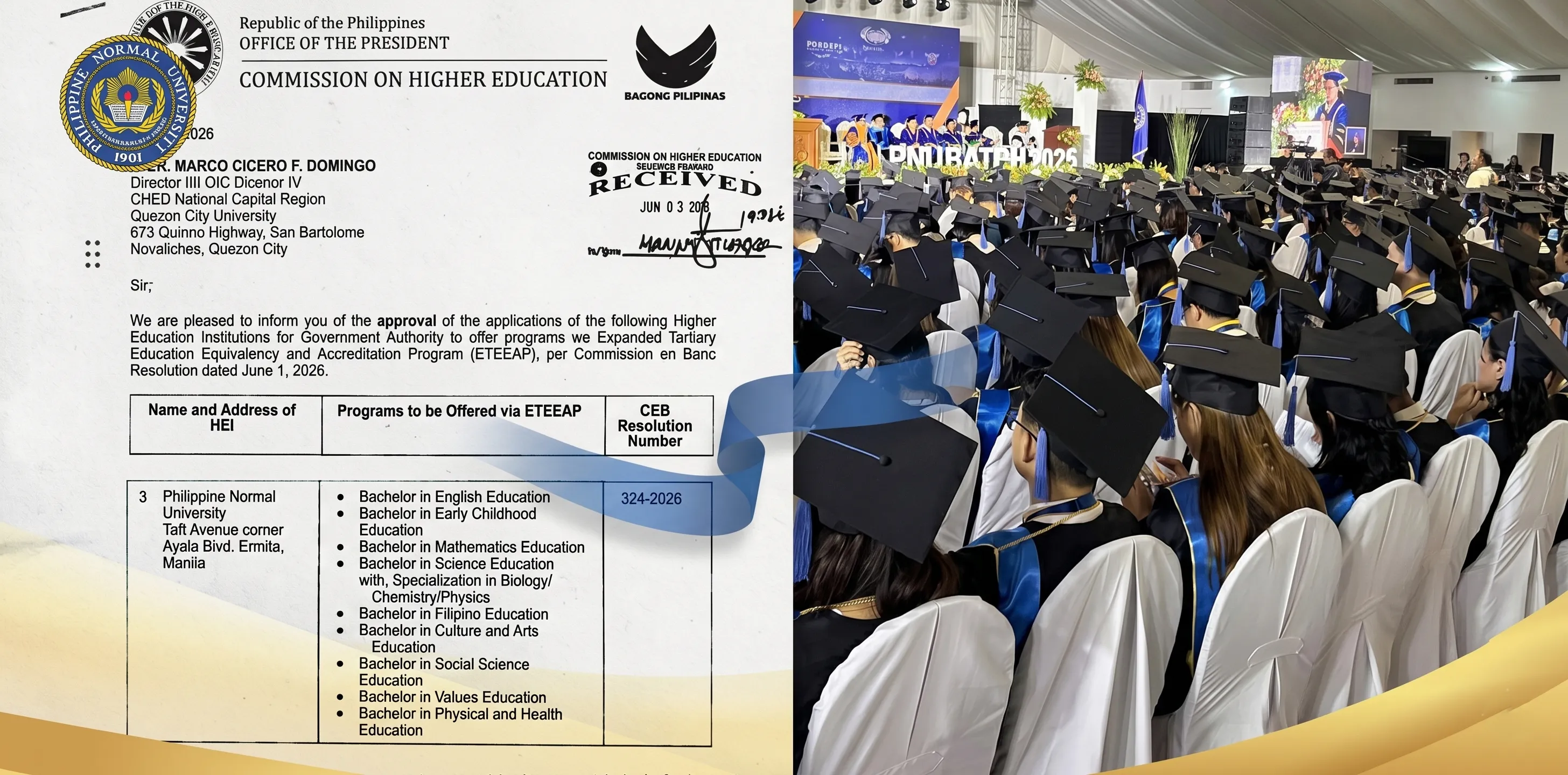
Ask the institution directly for its authority documents. A legitmate, deputized institution should be able to show you its CHED authority without hesitation. This includes the Commission en Banc resolution approving its deputization and, where applicable, its Certificate of Program Compliance (COPC).
Verify whether the specific program you want to enroll in is covered. Deputization is granted per program, not just per institution. A school may be authorized to offer a Business Administration degree through ETEEAP but not a Criminology degree. Ask about the specific program.
Check if the institution uses a modality that requires separate authorization. Schools offering programs through Open Distance Learning or e-learning must have a separate CHED authority for that modality. This is explicitly required under both RA 12124 and the Implementing Rules and Regulations issued in June 2025.
Red Flags to Watch Out For
Whether you are looking at an ETEEAP program, a traditional undergraduate degree, or a graduate program, the following signs should prompt further investigation before you commit.
A promise of completion in an unrealistically short time is a major warning sign. Legitimate ETEEAP programs involve real assessment processes that take time to conduct properly. Any provider promising a degree in a matter of weeks with minimal documentation should be treated with extreme skepticism.
Vague or absent information about the institution’s CHED recognition is another concern. Legitimate schools are proud of their accreditation and deputization status and will display it prominently. If you have to press hard to get a straight answer about authorization, that says something.
Heavy use of social media advertising without any verifiable institutional presence is also worth examining carefully. While legitimate institutions do use social media, a school that exists almost entirely on Facebook without a traceable physical address, faculty, or student body should be treated cautiously.
Fees that are dramatically lower than comparable programs at established institutions can also signal problems. Proper program delivery involves qualified assessors, administrative oversight, and genuine enrichment components. None of those are free.
Finally, programs that seem to guarantee a degree regardless of assessment outcomes are not offering accreditation at all. They are selling a document. Legitimate ETEEAP assessment can and does result in the identification of deficiencies that the applicant must address through enrichment programs or formal coursework before a degree is awarded.
Your Degree Should Count for Everything
The whole point of pursuing a degree as a working professional is to make it count: for your career, your family, and your future. Every peso you invest and every hour you put in should produce a credential that actually opens doors.
ETEEAP, as designed and regulated under RA 12124, is built on exactly that premise. The program exists to give real recognition to real experience, evaluated by qualified people, at institutions that are accountable to national standards. That accountability is what makes the degree legitimate.
If you are checking your eligibility or starting to compare programs and schools, the most important first step you can take is to confirm that any institution you are considering has the proper CHED authority for the specific program you want. The school directory, the program listings, and the eligibility guides on this site are all here to help you make that decision with confidence.
Your experience is real. Make sure the degree that represents it is too.
This post is for general informational purposes only. ETEEAP.PH is an independent guide. Always verify program details and institutional authorization directly with the deputized school of your choice.
Ready to take the next step? Browse accredited ETEEAP schools, explore available degree programs, or check if you qualify before you begin your application.