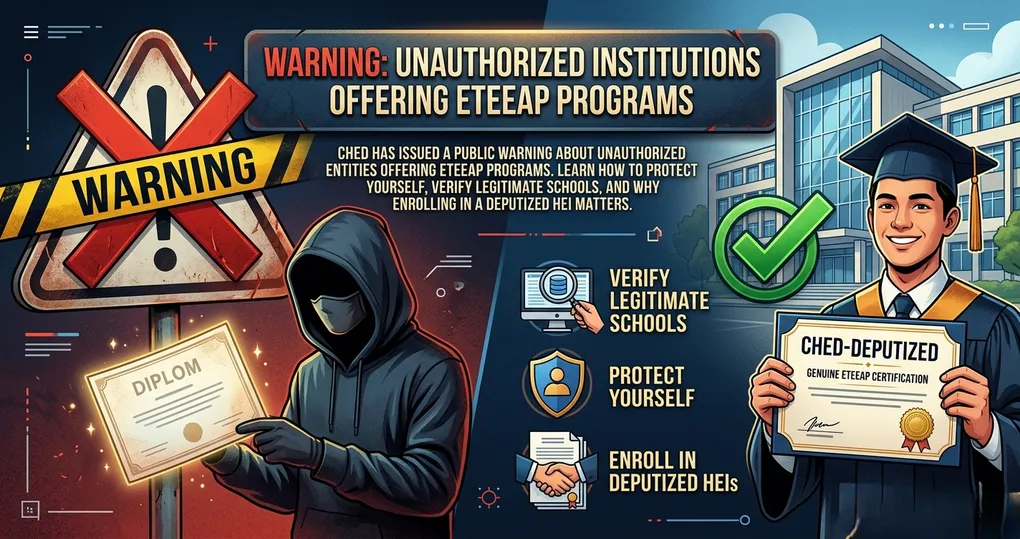
Warning: Unauthorized Institutions Offering ETEEAP Programs
Earning a college degree through your years of hard work and experience is one of the most meaningful things you can do for your career. The Expanded Tertiary Education Equivalency and Accreditation Program (ETEEAP) makes that possible for thousands of Filipino professionals every year. But before you take that step, there is something critically important you need to know: not every school or entity advertising ETEEAP programs is actually authorized to offer them.
The Commission on Higher Education (CHED) has officially raised the alarm about unauthorized entities that are misrepresenting themselves as legitimate ETEEAP providers. If you enroll in one of these schools, your degree may not be recognized, and your time and money could go to waste.
Sections in this guide:
- What CHED Actually Said
- Why This Matters More Than You Think
- How to Tell If a School Is Legitimately Deputized
- The Safest Step You Can Take: Verify First
- Red Flags to Watch Out For
- Who Is Eligible for ETEEAP?
- What ETEEAP Can Genuinely Do for You
- The Bottom Line
What CHED Actually Said
In an official statement, CHED confirmed that unauthorized entities have been offering higher education programs under the ETEEAP name. The commission specifically called out the risks: poor program quality, credentials that may not hold up, and institutions that do not follow proper educational standards.
The warning came directly from CHED Chairman J. Prospero E. De Vera III, who urged all prospective students to exercise due diligence before enrolling. The bottom line is simple: only Higher Education Institutions (HEIs) that have been officially deputized by CHED are allowed to offer ETEEAP programs.
Why This Matters More Than You Think
You might be wondering why someone would go through the trouble of setting up a fake or unauthorized ETEEAP program. The answer is straightforward: demand is high. ETEEAP is a legitimate and increasingly popular pathway for working professionals in the Philippines who want to earn a recognized college degree based on their skills and experience. That demand has created an opportunity for bad actors to exploit applicants who are not aware of the verification process.
The consequences of enrolling in an unauthorized institution can be serious. Employers, licensing boards, and government agencies recognize degrees from CHED-authorized schools. A diploma from an unauthorized provider may not open the doors you are counting on. In some fields, it could prevent you from taking licensure examinations altogether.
This is not a small risk. It is your career and your future.
How to Tell If a School Is Legitimately Deputized
The word “deputized” is important here. Under the ETEEAP framework, CHED grants specific institutions the authority to assess and award degrees through the program. This deputization is not permanent either. It is valid for five years and subject to regular renewal and evaluation.
To be deputized, an institution must meet strict requirements depending on its type:
Centers of Excellence or Development (COE/COD): Must hold recognized COE or COD status in the specific program they want to offer through ETEEAP.
State Universities and Colleges (SUCs): Must have at least Level IV accreditation status and hold a valid Certificate of Program Compliance (COPC).
Local Universities and Colleges (LUCs): Must have equivalent Institutional Recognition and a valid COPC for the programs offered.
Private HEIs: Must have Autonomous or Deregulated status.
These are meaningful standards. They exist precisely to protect students like you.
You can learn more about how deputization works on the ETEEAP page at ETEEAP.PH, which lays out the full framework including the legal basis and assessment process.
The Safest Step You Can Take: Verify First
Before you reach out to any school about ETEEAP enrollment, verify their deputization status. ETEEAP.PH maintains a directory of accredited schools where you can check which institutions are authorized. Visit the Accredited Schools page to browse the list or download the official PDF.
There is also a full school directory available if you want to search by region or program.
This one step can save you from a costly mistake.
Red Flags to Watch Out For
When researching ETEEAP providers, keep an eye out for warning signs that a school or entity may not be legitimate:
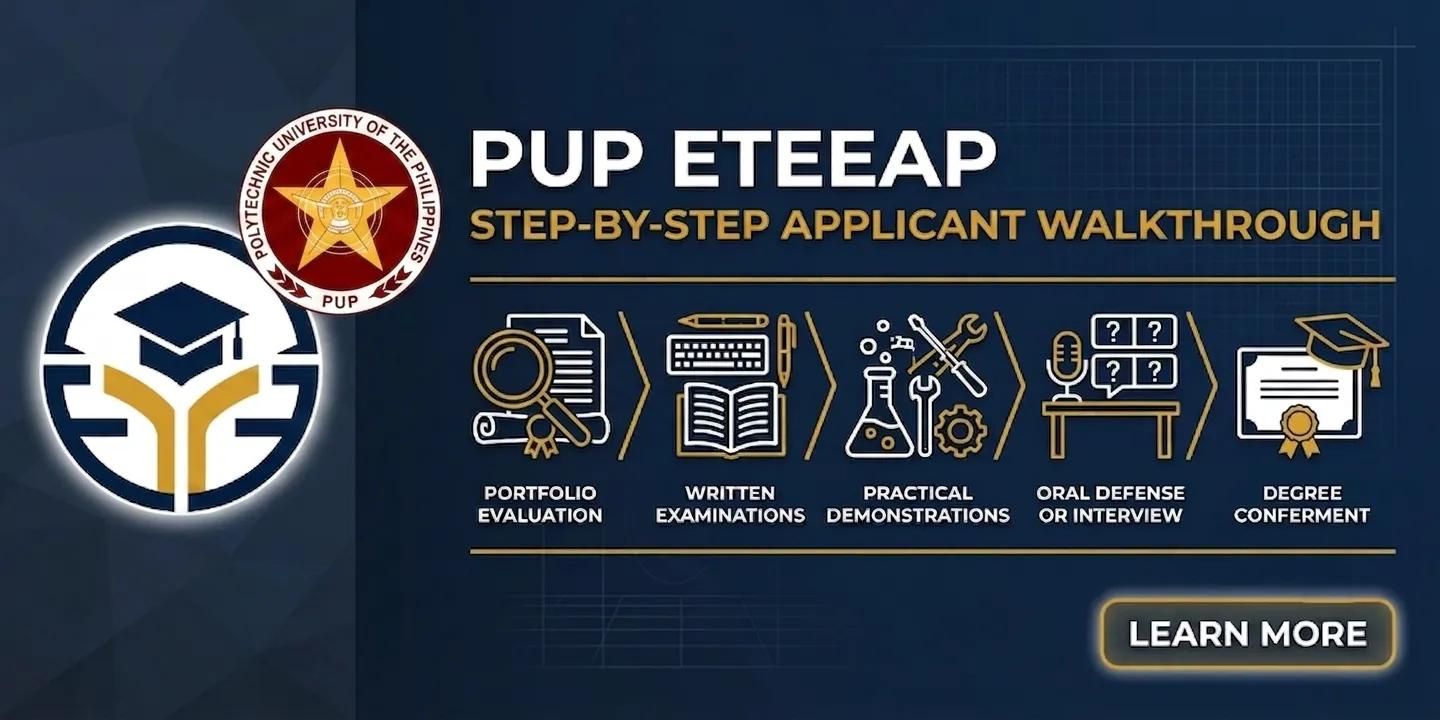
Unusually fast completion promises. Legitimate ETEEAP programs involve real assessment processes, including portfolio evaluation, written exams, practical demonstrations, and panel interviews. Any school promising a degree in a matter of weeks with minimal requirements should raise an immediate red flag.
No verifiable institutional background. A legitimate HEI will have a physical campus, a verifiable track record, and a history that you can check. If you cannot find any information about a school outside of its own website or social media pages, investigate further before committing.
Vague or missing accreditation details. Ask directly about the school’s deputization status and request documentation. A legitimate institution will be able to provide this information clearly and confidently.
Pressure to enroll quickly. High-pressure sales tactics are not how reputable schools operate.
Unusually low fees that seem too good to be true. While ETEEAP is generally more accessible than traditional degree programs, suspiciously low costs may indicate a provider cutting corners, or worse, operating without authorization.
Who Is Eligible for ETEEAP?
If you are exploring ETEEAP for the first time, it helps to know the basic qualifications. To apply, you generally need to be a Filipino citizen, at least 23 years old, a secondary education graduate or equivalent, and have at least five years of relevant work experience related to the degree you want to pursue.
You can check the full list of qualifications and documentary requirements on the eligibility page at ETEEAP.PH. Knowing what you qualify for also helps you ask better questions when talking to schools.
What ETEEAP Can Genuinely Do for You
For working professionals who have spent years building expertise in their field, ETEEAP is a real and valuable opportunity. It recognizes learning that happened outside the traditional classroom: work experience, non-formal training, technical skills, and life experience. Graduates earn the same CHED-recognized degree as any other college graduate and may even become eligible to take licensure examinations in certain fields.
The program has supported real professionals across the country, from those working in business and management to those in creative and technical fields. But that value only holds when you go through a legitimate, deputized institution.
For a broader look at what ETEEAP involves and how the process works, the ETEEAP overview at ETEEAP.PH is a good starting point.
The Bottom Line
CHED’s warning is not just bureaucratic noise. It is a genuine call to protect yourself before you invest time and money into a degree program. The good news is that verifying a school’s legitimacy is not difficult. The tools are available, the information is accessible, and the right institutions are ready to welcome qualified applicants.
Start by checking the list of accredited schools, confirm a school’s deputization status before you enroll, and never let the excitement of finally pursuing your degree push you into a decision you have not properly researched.
Your experience and hard work deserve to be recognized by a degree that actually counts. Make sure the institution you choose has earned the right to give it to you.