Regular Bachelor's Degree vs ETEEAP: What's the Real Difference?
In the Philippines, a college degree has long been treated as a requirement for career advancement. But the reality is that a lot of Filipinos spend years building real, valuable skills in the workforce without ever getting the chance to finish their studies. Life happens. Bills pile up. Priorities shift.
If you’re in that situation, you’ve probably wondered: is there another way to earn a degree without going through four more years of school?
That’s exactly what the Expanded Tertiary Education Equivalency and Accreditation Program, or ETEEAP, was designed for. But before you decide whether it’s the right path, it’s worth understanding how it actually compares to a traditional bachelor’s degree.
Sections in this guide:
- The Core Difference: How You Learn
- Who Each Path Is Built For
- Time Commitment
- How You’re Assessed
- Cost
- Is an ETEEAP Degree “Lesser” Than a Regular Degree?
- Which One Should You Choose?
The Core Difference: How You Learn
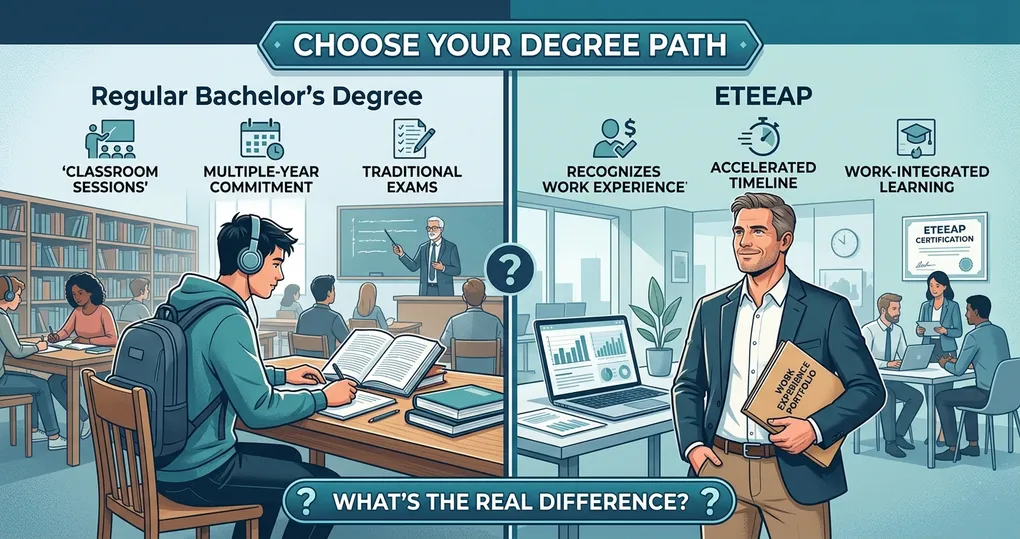
A regular bachelor’s degree is built around structured academic learning. You attend classes, take exams every semester, complete requirements, and progress year by year through a fixed curriculum. It typically takes four years to finish, sometimes longer depending on the program or any interruptions along the way.
ETEEAP works from a completely different starting point. Instead of measuring what you learn inside a classroom, it evaluates what you already know from years spent working in your field. Your professional experience, job training, certifications, and skills are assessed against the learning outcomes of a college degree program. If your experience matches what a degree program requires, you can earn that degree without sitting through semesters of coursework you’ve essentially already lived through.
Both pathways lead to the same result: a bachelor’s degree recognized by the Commission on Higher Education (CHED). The difference is entirely in the journey.
Who Each Path Is Built For
Traditional degree programs are best suited for students who are building their knowledge from the ground up, usually right after high school. They benefit from structured guidance, campus life, and the gradual development that comes with years of formal study.
ETEEAP, on the other hand, was designed specifically for working professionals. To qualify for ETEEAP, you generally need to be at least 23 years old, have completed secondary education, and have a minimum of five years of relevant work experience in the field related to the degree you’re pursuing. Overseas Filipino Workers (OFWs) are also strongly encouraged to apply, since international work experience counts toward the assessment.
If you’ve already spent years doing the work, ETEEAP gives your experience a formal academic value.
Time Commitment
One of the most practical differences comes down to time. A regular degree follows a fixed, multi-year schedule. ETEEAP doesn’t operate the same way. Because it’s assessment-based rather than coursework-based, the timeline depends on your readiness and the specific requirements of the Higher Education Institution (HEI) you apply through.
For professionals who are already employed full time, the flexibility this offers is significant. You’re not signing up for four more years of school. You’re going through an evaluation process that recognizes what you’ve already done.
How You’re Assessed
In a traditional degree program, your grades reflect attendance, quizzes, long exams, projects, and participation across multiple semesters. Everything is ongoing and cumulative.
ETEEAP uses a competency-based assessment model. Depending on the program and institution, this may include a portfolio evaluation where you document and present your professional background, a skills demonstration or practical exam, a written examination, and an interview or oral defense with a panel. The goal isn’t to test whether you attended class. It’s to verify that you’ve mastered the competencies the degree program requires.
You can learn more about how ETEEAP works including the full assessment process and what deputized institutions look for.
Cost
Traditional degree programs charge tuition every semester, and those costs add up significantly over four-plus years, on top of books, fees, and other expenses.
ETEEAP costs vary by institution and program, but because the process is compressed into an evaluation rather than years of coursework, the overall financial commitment tends to be lower. That said, exact fees depend entirely on which accredited school you choose. It’s always worth contacting your chosen HEI directly to get accurate figures.
Is an ETEEAP Degree “Lesser” Than a Regular Degree?
This is probably the most common misconception worth addressing head-on.
No, it is not. An ETEEAP degree is not an alternative certificate or a shortcut credential. It is a full, legitimate bachelor’s degree officially recognized by CHED, carrying the same academic weight as a degree earned through the traditional path. Employers across the Philippines recognize it. Graduates may also take licensure examinations where applicable, depending on the program.
The frequently asked questions page at ETEEAP.PH addresses this directly, along with other common concerns about the program.
Which One Should You Choose?
There’s no universal right answer because the two paths serve different people at different points in their lives.
If you’re a student who is just starting out and wants a structured learning environment with campus experience, a traditional bachelor’s degree makes complete sense. You’ll build knowledge progressively in a guided setting, and you’ll have time to explore your field before committing to a career.
But if you’ve already spent years working, if you’ve developed real competencies in a specific field, and if what you’re missing is the formal recognition of what you’ve already accomplished, ETEEAP is worth looking into seriously. It exists precisely for professionals who have done the work but don’t yet have the diploma to show for it.
You can explore available degree programs offered through ETEEAP to see if your field is covered, and check your eligibility before reaching out to an accredited school.
Your experience has value. ETEEAP is how you make it official.