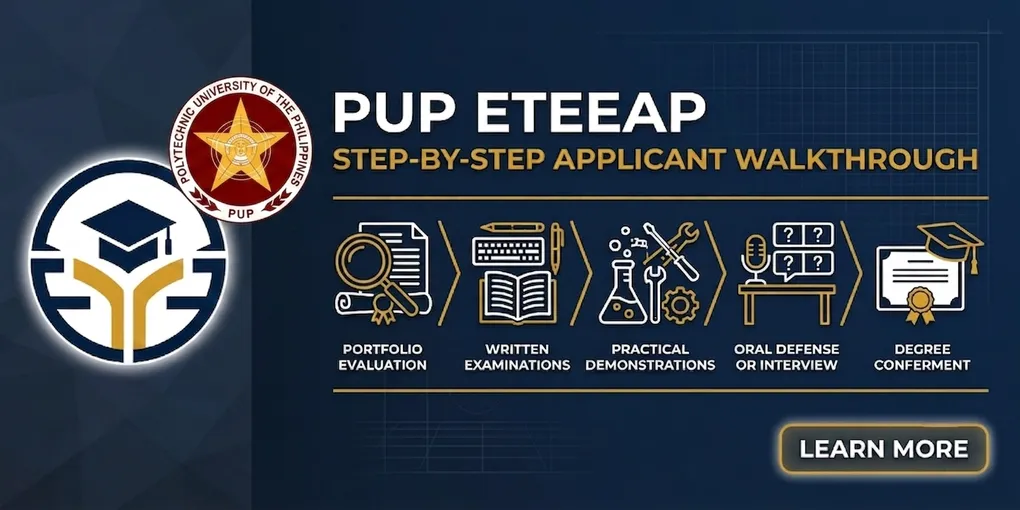
Polytechnic University of the Philippines (PUP) ETEEAP: A Step-by-Step Applicant Walkthrough
If you have been quietly Googling “PUP ETEEAP process” at midnight, hoping to find someone who has actually gone through it and lived to tell the tale, this guide is for you. Application guides online tend to read like government forms. Helpful, sure, but they rarely tell you what the experience actually feels like once you walk through the door.
So we put together this walkthrough based on a recent applicant’s firsthand account of going through the Polytechnic University of the Philippines (PUP) ETEEAP application. PUP runs its program through the Institute of Non-Traditional Studies (INE), and you can browse their official program page at https://www.pup.edu.ph/ous/ine/eteeap/. Think of what follows as the unofficial companion to that page, the version with the queues, the photocopy runs, and the realistic timelines.
A quick note before we start. Office locations, contact persons, and procedures can shift from year to year, especially as PUP continues to expand its facilities (we recently covered the new PUP Open University building that is meant to support exactly this kind of flexible learning). Always confirm current details directly with PUP before heading out. Treat this as a roadmap only.
Here is what we will walk through:
- Available Undergraduate Programs
- Before You Even Leave the House: Document Prep
- Documents to Prepare
- Where to Go and What to Expect
- Finding Your Way to the ETEEAP Office
- The First Assessment: Will Your Course Be Approved?
- Paying the Application Fee
- The Waiting Game
- The Subject Assessment and Narrative Reports
- Enrollment: Dates, Limits, and Payment Terms
- Reminders
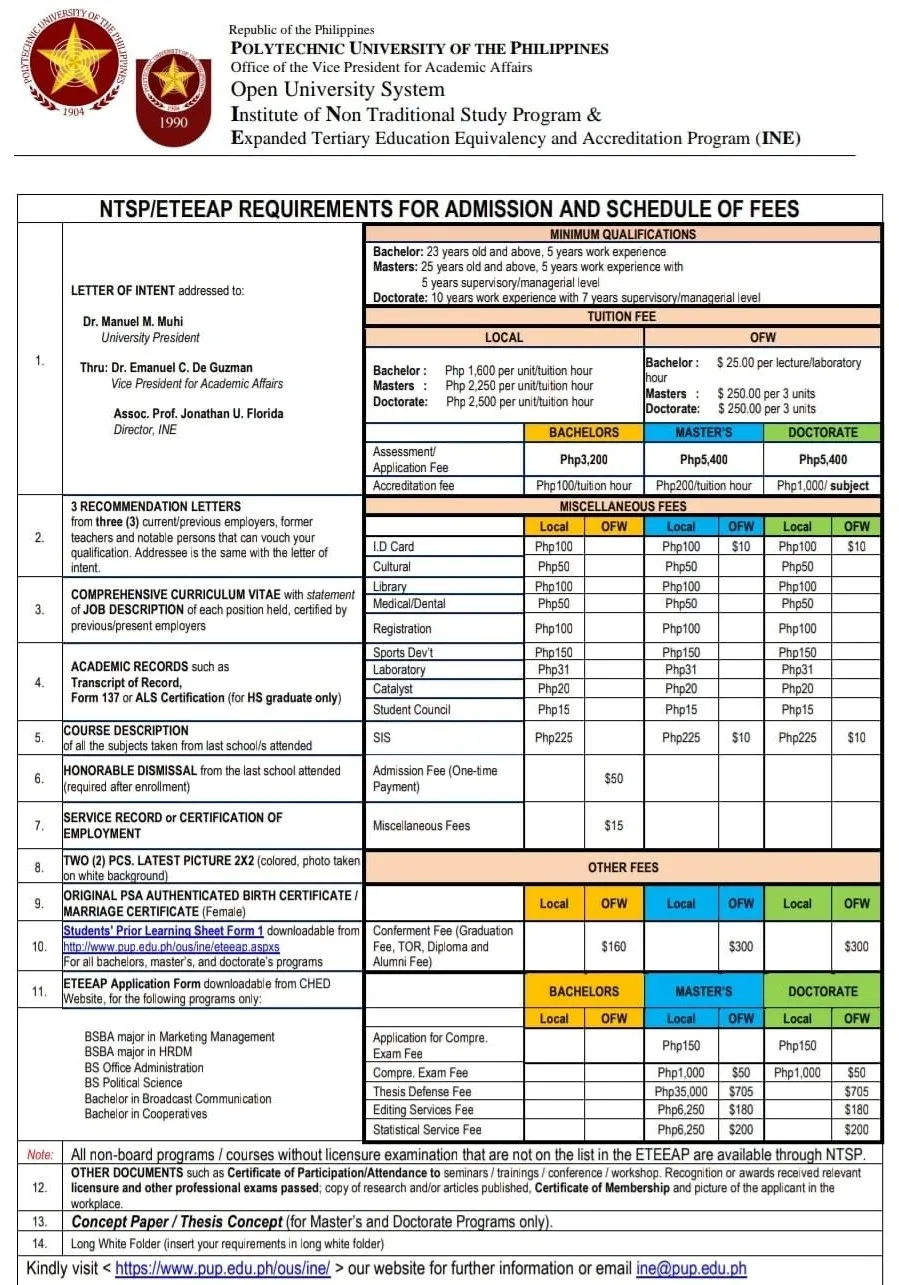
Below is the official PUP ETEEAP/NTSP requirements for admission and fees sheet for quick reference:
Available Undergraduate Programs
PUP’s ETEEAP currently accepts applicants for the following degree programs:
- Bachelor of Science in Business Administration major in Marketing Management
- Bachelor of Science in Business Administration major in Human Resource Management
- Bachelor of Science in Office Administration
- Bachelor of Arts in Broadcasting
- Bachelor of Arts in Political Science
- Bachelor of Science in Cooperatives
- Bachelor of Arts in Sociology
Before You Even Leave the House: Document Prep
This is the part that saves you the most time, and it is also the part most people underestimate. PUP’s ETEEAP office processes a steady stream of applicants every day, so anything you can prepare in advance keeps you from making a second or third trip.
According to a recent applicant, three things made the biggest difference. First, get your ETEEAP application form notarized before you arrive. Second, have your resume or CV notarized as well. Third, go through the list of requirements on PUP’s official page and make sure your documents are complete before you go. PUP’s own requirements page, listed under “More Information” on their ETEEAP section, breaks down exactly what is expected, so it is worth a careful read before you start photocopying anything.
Why notarize ahead of time? Because the lines for notarial services near campus can be brutal, and the ETEEAP office itself does not offer notarization. If your form or resume is missing that stamp, you will likely be told to come back, and that means another trip across the city. Print everything, and bring more copies than you think you need. Reviewers will often flip through your portfolio on the spot, so a thick but organized folder works in your favor.
If you want a sense of the general qualifications before you even reach this stage, our eligibility guide runs through the basics: Filipino citizenship, being at least 23 years old, having a high school diploma or its equivalent, and at least five years of relevant work experience. PUP follows these same baseline requirements, on top of whatever additional documents the INE office may ask for.
Documents to Prepare
Before heading to the campus, applicants should print and complete all required documents, including a letter of intent addressed to the university president (through the Vice President for Academic Affairs and the Director of the Institute of Non-Traditional Studies and ETEEAP), recommendation letters from three notable persons such as former employers, supervisors, or teachers, academic records like Form 137 or a transcript of records, a comprehensive curriculum vitae detailing the duties and responsibilities of each job held, certificates of employment, an authenticated PSA birth certificate (or marriage certificate for married women), 2x2 photos, the ETEEAP Application Form, and the Student’s Prior Learning Sheet (Form 1). The application form and Form 1 can both be accessed through QR codes provided on PUP’s official ETEEAP page.
A practical tip many applicants share: it helps to have the ETEEAP application form and your resume/CV notarized in advance, and to make sure every requirement listed on the official website is already complete before your visit. PUP’s offices can involve long lines, so being fully prepared in one trip can save a lot of back-and-forth.
Where to Go and What to Expect
According to PUP’s official guidelines, documents should be submitted to the Office of the Institute of Non-Traditional Study Program and ETEEAP. Based on recent applicant experiences, this office is located on the 3rd floor of the Ninoy Aquino Building inside PUP’s Main Campus—simply ask the guard or information desk for directions to the ETEEAP office.
A general walkthrough of the on-campus process looks like this:
- Submit your documents. Bring printed copies of all your requirements to the ETEEAP office for initial checking and assessment.
- Initial assessment. Staff will review your documents to confirm completeness and check whether your work background aligns with the course you’re applying for. Many applicants are informed on the same day whether they’ve been cleared to proceed.
- Pay the application fee. If cleared, you’ll be issued a payment slip for the application fee (around ₱3,200, though applicants should confirm current rates on PUP’s official fee schedule). Payment is typically made at the cashier in the Main Building, which accepts cash only—though a Landbank ATM is usually available nearby. It’s a good idea to photocopy the payment slip and official receipt for your records before returning to the ETEEAP office.
- Wait for the subject assessment schedule. After submitting proof of payment, applicants are advised to wait—commonly anywhere from two weeks to about a month—for an email regarding the assessment of subjects to be credited or taken.
- Register online. Once notified, applicants follow the instructions in the email to register, which aligns with PUP’s official Step 5 of logging in to the iApply portal for online registration and profile uploading.
- Discuss your subject assessment. Applicants return to PUP to go over which subjects have been credited based on their prior learning and work experience, and which ones still need to be taken.
- Submit narrative reports (if required). For certain minor subjects, candidates may be asked to write narrative reports detailing relevant experience, which can help reduce the number of subjects they need to formally enroll in. The number required varies per applicant.
- Enroll in your subjects. Once cleared, applicants can enroll the same day or return at a later date to submit narrative reports and complete enrollment.
Finding Your Way to the ETEEAP Office
PUP’s main campus along Anonas Street in Sta. Mesa, Manila can feel like its own small city, especially if it is your first time there. According to the applicant’s account, the simplest approach is to head toward the Ninoy Aquino Building and tell the guard or the information desk that you are there for an ETEEAP application. From there, you will be directed to the ETEEAP office, which the applicant described as being on the third floor, on the right-hand side of the building.
It is worth noting that PUP’s official ETEEAP page lists the Institute of Non-Traditional Study Program and ETEEAP office as being located at the 4th Floor of the NALLRC (National Academic Library and Learning Resource Center) on the same campus. Office assignments can change, especially with new buildings opening, so this is exactly the kind of detail you should confirm with the guard or information desk on the day you visit. Either way, mentioning “ETEEAP application” to campus security is usually enough to get pointed in the right direction.
Once you find the office, hand your printed documents to the staff who handle assessments. The applicant specifically mentioned two names, Sir Nixon and Sir John, though of course staff assignments can change over time. The person who receives your documents will check whether your background is a good fit for the course you are applying for.
The First Assessment: Will Your Course Be Approved?
Here is something that surprises a lot of first-time applicants: you often find out the same day whether your chosen course lines up with your work experience. The staff will review your documents on the spot and assess whether your professional background is “aligned” with the degree program you want.
If everything checks out, you get what the applicant called a “go signal.” This is essentially a green light to proceed with the application, and it comes with a slip authorizing you to pay the application fee.
If your background does not quite match the program you originally had in mind, do not panic. This is fairly normal, and it is part of why the assessment exists in the first place. The staff may suggest a more closely aligned program based on your actual work history. PUP’s ETEEAP page lists several undergraduate programs open for accreditation, including Business Administration majors in Marketing Management and Human Resource Management, Office Administration, Broadcasting, Political Science, Cooperatives, and Sociology. If you are still deciding which path makes the most sense for your career, our guide on choosing the right ETEEAP program for your career can help you think it through before your visit.
Paying the Application Fee
Once you have your go signal slip, photocopy it twice before you do anything else. You will need these copies later, and the photocopying area on campus, according to the applicant, is located near the middle of the campus, past the circle where many of the food stalls are.
From there, head to the cashier at the Main Building. Ask the guard for directions if you are unsure, since the Main Building is a separate structure from where the ETEEAP office is located. Be prepared for a long line. Cashier queues at PUP tend to move slowly, especially during peak enrollment periods. The application fee mentioned by the applicant was 3,200 pesos, though fees can be revised from year to year, so treat this as a reference point rather than a fixed number. If you are budgeting for the program as a whole, our ETEEAP cost breakdown gives a wider picture of what applicants typically spend from start to finish.
Good news for anyone who forgot to bring exact cash: there is a Landbank ATM right beside the cashier, since payment is accepted in cash only. Once you have paid, photocopy your official receipt as well. Then make your way back to the ETEEAP office.
The Waiting Game
Back at the ETEEAP office, hand over your receipt along with your slip. At this point, the bulk of your in-person work for this visit is done. The staff will let you know that the next step is the assessment of subjects, and this is where patience becomes part of the process.
How long does it take? Based on the applicant’s experience, it varies quite a bit. Some applicants hear back within two weeks. Others wait three weeks, and some wait closer to a month. There is no fixed schedule that applies to everyone, since it depends on the volume of applications the office is handling and how quickly assessors can review each portfolio.
The takeaway here is simple: do not show up at the office every other day asking for updates. Give it time, keep an eye on your email, and use the waiting period productively. If you have gaps in your training history, this might be a good window to look into free and affordable online courses with certificates that could strengthen your portfolio later in the process.
The Subject Assessment and Narrative Reports
Once PUP emails you, the instructions in that email will tell you what to do next, usually involving registration through their online system. From there, you will be asked to return to PUP to discuss the results of your subject assessment. This is the part where the panel maps your work experience and prior learning against the actual curriculum of your chosen degree, identifying which subjects you can skip and which ones you still need to take.
A common requirement at this stage, according to the applicant, is the submission of narrative reports for minor subjects. These reports essentially document your relevant experience in a written format, and they can help reduce the number of subjects you need to formally enroll in. How many narrative reports you will need to write varies from applicant to applicant, so this is something your assessor will discuss with you directly during this visit.
You actually have some flexibility here. You can choose to enroll on the same day you discuss your assessment results, or you can go home, prepare your narrative reports, and come back later to submit them along with your enrollment.
Enrollment: Dates, Limits, and Payment Terms
This is the part that trips up a lot of applicants, mainly because the academic calendar for ETEEAP students follows its own rhythm, somewhat separate from the regular school year.
If you are aiming for summer enrollment, the window typically runs until June, with classes starting sometime between July and August. Keep in mind that summer enrollment usually caps out at five subjects, so this is not the term to try to clear your entire backlog in one go.
For those enrolling in the first semester instead, registration generally opens during the second week of August, with classes beginning sometime between September and January.
One detail that applicants seem to genuinely appreciate is that PUP allows you to split your subject load across multiple terms. If your full assessment results in something like eleven subjects for a single semester, that is a heavy load for anyone juggling a full-time job. Spreading those subjects across two or more terms is an option, and it is worth discussing with your assessor if your course load feels overwhelming.
As for payment, the applicant noted a fifty-fifty arrangement: half of your tuition and fees is paid upon enrollment, and the remaining half is due before the end of the semester. This kind of staggered payment can make a real difference if you are budgeting around a regular paycheck.
ETEEAP follows PUP’s academic calendar, with two main enrollment windows:
- Summer term: Enrollment typically runs until June, with classes starting in July and ending in August. A maximum of five subjects can be enrolled per summer term.
- First semester: Enrollment generally opens in the second week of August, with classes running from September to January.
Reminders
Reading through someone else’s actual experience tends to demystify a process that, on paper, can look intimidating. The PUP ETEEAP journey involves real queues, real photocopying runs, and real waiting periods, but it is also a well-worn path that thousands of working Filipinos have completed before you. Because requirements, fees, and processing times can be updated, and waiting periods for assessment results can vary from two weeks to a month, applicants are encouraged to regularly check PUP’s official channels for the latest information and to be prepared for some waiting between steps. For the most accurate and up-to-date details on requirements, fees, and admission procedures, visit PUP’s official ETEEAP page:
🔗 https://www.pup.edu.ph/ous/ine/eteeap
If you are still in the early stages of figuring out whether ETEEAP is right for you, start with our ETEEAP overview and our eligibility checker. And if PUP is not the only school on your shortlist, our directory of accredited schools is a good next stop for comparing your options.
Whatever stage you are at, remember that the years of experience you have already put in are the real foundation of this application. The paperwork, the lines, and the waiting are simply the bridge between that experience and the diploma that finally puts it on paper.
For more practical, real-world guides like this one, keep checking back on ETEEAP.PH.