How to Avoid Scammers and Fake Middlemen Offering ETEEAP
You have probably seen the posts. A Facebook page or a group chat message promising to “process” your ETEEAP degree for you, no exams, no panel interview, just hand over your documents and a fee and wait for your diploma. It sounds like exactly what a busy working professional wants to hear. Unfortunately, it is also one of the clearest signs that you are talking to a scammer, not a school.
ETEEAP is a real, legally recognized pathway to a college degree, and it works. Thousands of Filipinos have used it to finally get the diploma their years of work experience already earned them. But the program runs through specific, deputized schools, not through agents, consultants, or “facilitators” who insert themselves between you and the institution. Knowing the difference can save you years of effort and a significant amount of money.
Sections in this guide:
- Why Middlemen Are Suddenly Everywhere
- What a Middleman Actually Looks Like
- Why the Law Doesn’t Leave Room for Agents
- The Tactics They Use to Reel You In
- How to Tell You’re Dealing With a Legitimate School
- What to Do If You Already Paid Someone
- The Bottom Line
Why Middlemen Are Suddenly Everywhere
The Expanded Tertiary Education Equivalency and Accreditation Program (ETEEAP) used to be a fairly quiet, under-the-radar option. That changed once Republic Act No. 12124 institutionalized the program nationwide and the Commission on Higher Education (CHED) began actively deputizing more schools to offer it. More awareness means more applicants, and more applicants mean more demand. Wherever there is demand for something people genuinely want, especially something tied to a diploma, opportunists tend to show up.
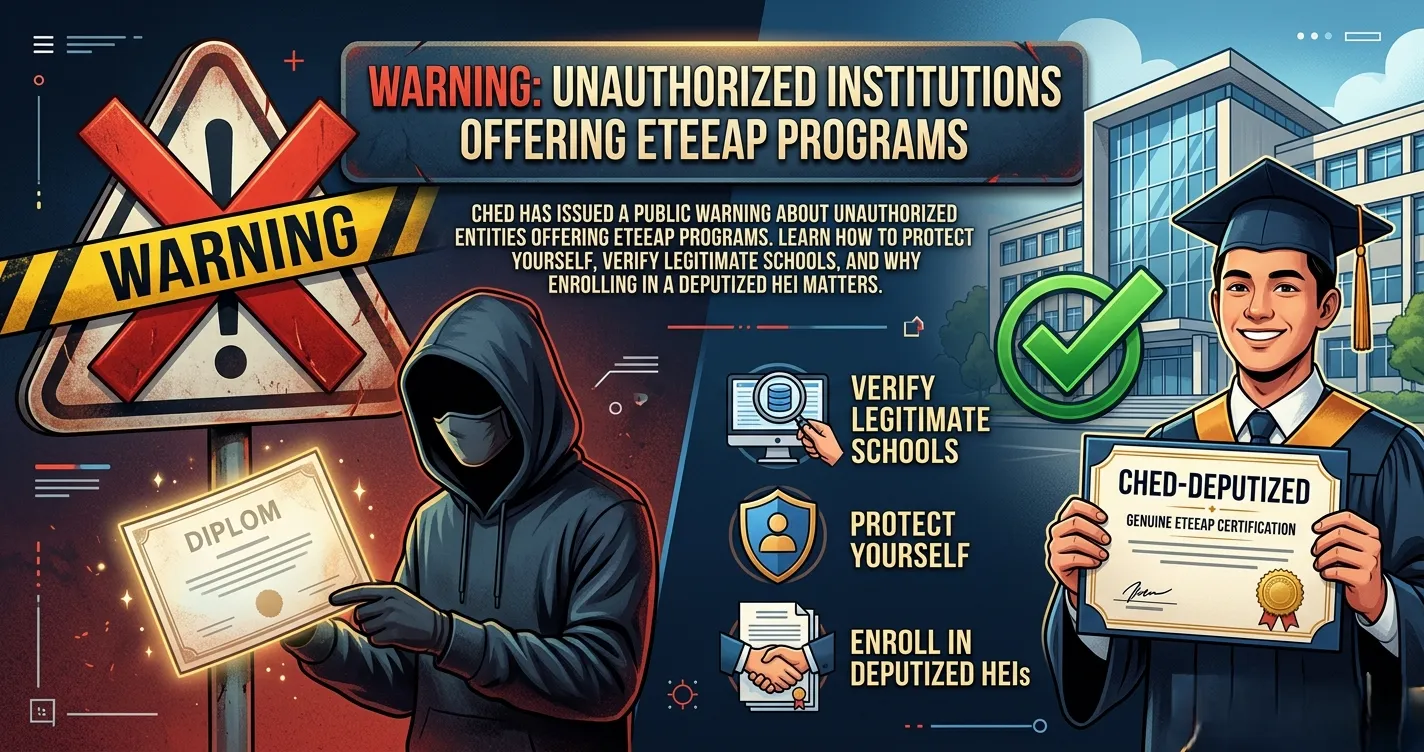
That is exactly what is happening now. People who have no actual connection to a deputized school, sometimes none at all to the education sector, are positioning themselves as ETEEAP “consultants” or “processors.” They promise speed, convenience, and a degree without the parts of the program that actually make it credible: the portfolio review, the written assessment, the practical demonstration, and the panel interview. CHED has already had to publicly warn the public about this exact pattern. You can read more about that warning in our earlier post, Warning: Unauthorized Institutions Offering ETEEAP Programs.
What a Middleman Actually Looks Like
It helps to be specific here, because the people running these setups rarely call themselves scammers. They call themselves “ETEEAP coordinators,” “education consultants,” or simply someone who “knows people” at a school. A few common patterns to watch for:
Someone who contacts you first, usually through social media, rather than you reaching out to a school. Someone who insists you coordinate everything through them rather than directly with the HEI’s ETEEAP office. Someone who cannot name which specific, deputized school your degree will come from, or who keeps changing the answer. Someone who asks for full payment upfront, in cash, with no official receipt from a school. And someone who cannot explain, clearly and specifically, what the actual assessment process will involve.
None of these patterns automatically prove fraud on their own. But when two or three show up together, you are very likely dealing with someone whose business model depends on you never finding out who is actually behind your diploma.
Why the Law Doesn’t Leave Room for Agents
This is the part that gets lost in all the social media noise: the legal structure of ETEEAP simply does not include a role for private middlemen. Under Republic Act No. 12124, CHED is named the lead agency for the entire program, and it is CHED, not any individual or private company, that has the power to deputize a higher education institution and grant it the authority to assess applicants and award degrees.
Once a school is deputized, the law spells out exactly who handles your application from there. The Implementing Rules and Regulations of RA 12124 state plainly that an applicant obtains the application form from a deputized HEI or downloads it directly, then submits the completed form along with supporting documents straight to that school. The deputized HEI is the one that reviews your application, constitutes the panel of internal and external assessors, conducts the portfolio evaluation, administers the written and practical assessments, and ultimately awards the equivalency credit. There is no provision anywhere in the law for a third-party agent to manage this process on a school’s behalf or to guarantee an outcome in exchange for a fee.
So when someone offers to be your “go-between,” ask yourself a simple question: what, exactly, are they being paid for? A legitimate deputized school will accept your application directly, often at no cost beyond the standard assessment and tuition fees set by the institution itself under CHED guidelines. If a person is charging you extra simply to “connect” you to a school, that fee exists for their benefit, not because it is required to enroll.
The Tactics They Use to Reel You In
Scammers and unauthorized “processors” tend to lean on a handful of tried and tested pressure tactics, and once you have seen them named, they become much easier to spot.
The promise of an unusually fast turnaround is probably the biggest one. A real ETEEAP assessment takes time. It involves a genuine review of your portfolio, real written and practical exams, and an actual panel interview with internal and external assessors. Anyone telling you that you can have a finished degree in a matter of weeks, with little more than a payment and a photocopy of your resume, is describing something that does not match how the program actually works.
Vagueness about the school is another tell. Ask which specific HEI will issue your degree and watch how they answer. A legitimate facilitator, if one is genuinely working in partnership with a real institution, should be able to name the school immediately and let you verify it yourself. Hesitation, deflection, or a name that changes between conversations should make you pause.
Pressure to decide quickly, before you have had a chance to verify anything, is a classic sales tactic that reputable schools generally do not need to rely on. Neither do unusually low prices that undercut every deputized school you can find, since cutting corners on an actual assessment process tends to be the only way to offer that kind of “discount.” And finally, watch for anyone who discourages you from contacting CHED or the school directly to confirm details. A person with nothing to hide will never mind you double-checking their claims.
How to Tell You’re Dealing With a Legitimate School
The good news is that verifying legitimacy does not require any special skill. It mostly comes down to going to the source instead of the middleman.
Start with the school itself. Every deputized HEI is required to have a dedicated office or unit overseeing its ETEEAP implementation, with its own staff and its own application process. Reach out to that office directly using contact information from the school’s own official channels, not a number or page someone else gave you. You can browse a list of authorized institutions on our Accredited Schools page, or search by region and program using the full school directory.
Ask about deputization status directly and expect a clear, confident answer. Deputization under RA 12124 is valid for five years and subject to renewal, so it is worth confirming that a school’s authority is current rather than expired or pending. A legitimate institution will not hesitate to discuss this with you.
It also helps to know what you are walking into before you start talking to anyone. Review the actual qualifications, age, citizenship, educational attainment, and the minimum five years of relevant work experience, on our eligibility page, and take a look at the general overview of how the program works on our ETEEAP page. The more you understand about the real process, the faster you will notice when someone’s pitch does not add up.
What to Do If You Already Paid Someone
If you have already handed money to someone claiming to process your ETEEAP application and something now feels off, do not wait to act. Stop any further payments immediately, and gather everything you have, screenshots of conversations, receipts, names, and any documents you were given.
CHED has actively encouraged the public to come forward with exactly this kind of concern, whether it involves your own diploma or someone else’s. The commission has stated that anyone with doubts about a diploma’s legitimacy, or about a school or individual offering unauthorized programs, should report it directly rather than stay quiet. You can read more about this advisory in our related post, May Concern Ka Ba Sa Diploma Mo? Ano ang Ibig Sabihin ng Bagong Advisory ng CHED.
From there, your safest next step is to contact a deputized school directly to ask what your actual options are. If you genuinely meet the program’s qualifications, you can still pursue a legitimate degree through a proper, authorized channel. It simply means restarting the process the right way, this time without anyone standing between you and the institution.
The Bottom Line
ETEEAP rewards real experience with a real, recognized degree, and the process to get there is honestly not complicated once you know where to look. You do not need a connection, a contact, or a “guy who knows someone.” You need a deputized school, your documents, and the willingness to go through an honest assessment of what you already know how to do.
Anyone asking to stand between you and that school, especially for a fee, is adding a risk that simply does not need to exist. Go straight to the source, verify everything, and let your years of hard work speak for themselves in front of the people who are actually authorized to recognize it.
Ready to start the right way? Check the official list of accredited schools, confirm your eligibility, and apply directly through a CHED-deputized institution. No middleman required.