How to Apply for ETEEAP: A Quick Guide for Working Professionals
You’ve been working for years. You know your field inside and out. But without a college diploma, certain doors remain closed — promotions, salary adjustments, civil service eligibility, and professional licensure all require that credential. The Expanded Tertiary Education Equivalency and Accreditation Program, or ETEEAP, exists precisely for people in your situation.
The question most working adults ask isn’t “What is ETEEAP?” — it’s “How do I actually start?” This guide walks you through every step, from checking your eligibility all the way to crossing the graduation stage.
Sections in this guide:
- Step 1: Check If You Qualify
- Step 2: Choose the Right Program and Find a CHED-Deputized School
- Step 3: Prepare Your Documentary Requirements
- Step 4: Submit Your Application and Undergo Assessment
- Step 5: Complete the Enrichment Phase
- Step 6: Graduate and Receive Your Degree
- Is ETEEAP Right for You?
Step 1: Check If You Qualify
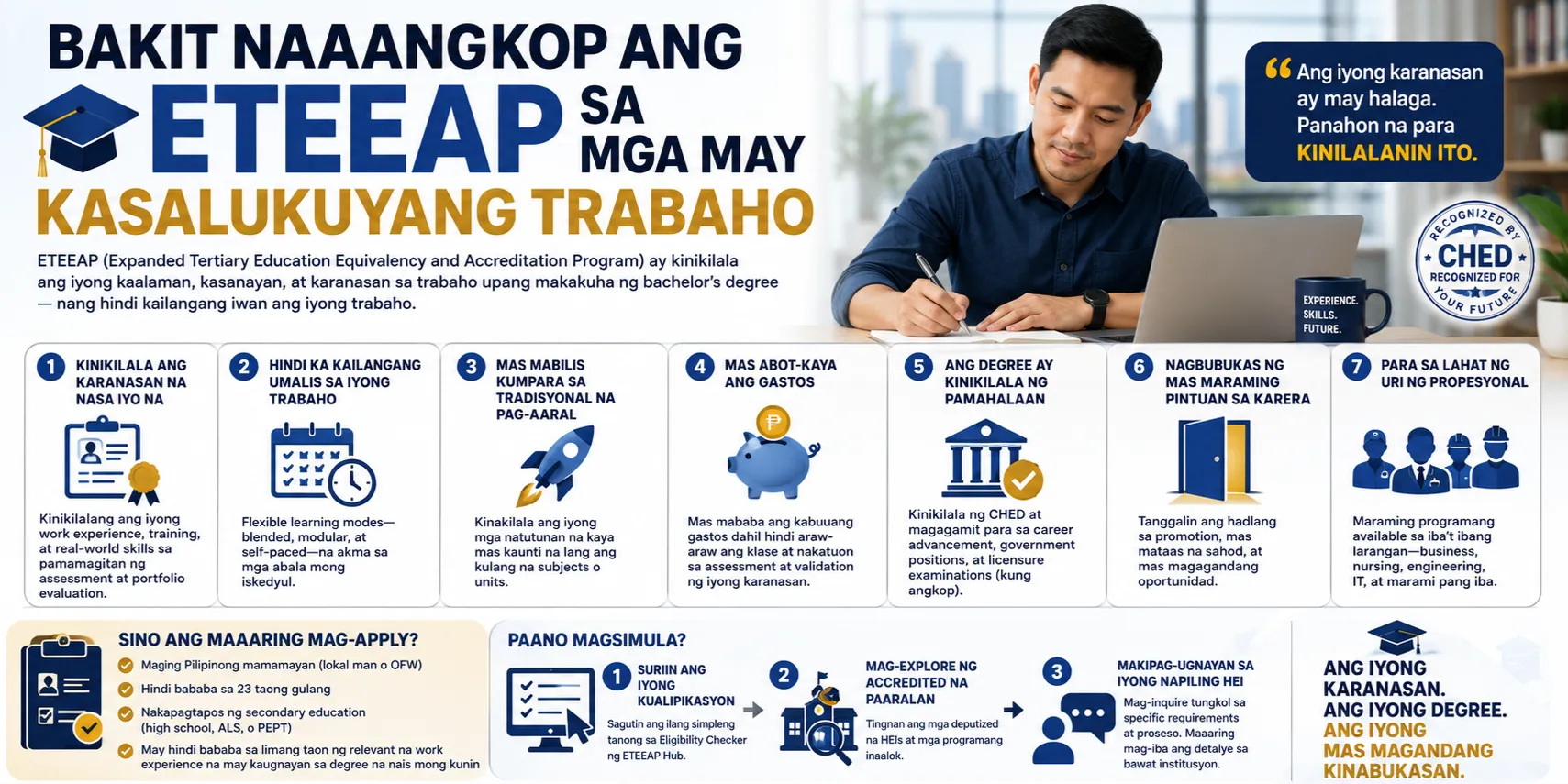
Before anything else, you need to be honest with yourself about whether you meet the basic requirements. ETEEAP was designed specifically for working Filipino adults, not fresh graduates looking for a shortcut.
Here are the core eligibility requirements:
Filipino citizenship. The program is a government initiative created for Filipino professionals. Whether you are working here in the Philippines or abroad as an OFW, you are eligible to apply. In fact, ETEEAP is an especially strong fit for overseas workers who have built deep, documented work experience over many years.
At least 23 years old. The minimum age requirement reflects the program’s intent. Assessors expect you to have lived and worked in the real world, not just completed secondary school.
High school or senior high school graduate. Under the old curriculum, a four-year high school diploma is sufficient. If you went through the K–12 system, you need to have completed senior high school. Graduates of the Alternative Learning System (ALS) also qualify.
At least five years of relevant work experience. This is the most critical requirement and also the most specific. Your experience must be directly related to the degree you want to earn. An ESL teacher applying for a Bachelor of Secondary Education makes sense. A service crew member at a restaurant applying for a Bachelor of Industrial Technology major in Food Service Management makes sense. A business owner with complete permits applying for a BS in Business Administration makes sense. The alignment between your work history and your chosen program is what assessors will scrutinize most carefully.
You can use the Quick Eligibility Checker at ETEEAP.PH to estimate whether you meet the basic criteria before taking any further steps.
Step 2: Choose the Right Program and Find a CHED-Deputized School
Selecting the right degree program and finding an authorized school go hand-in-hand. Because ETEEAP credits your past work experience, your degree choice must closely align with the actual work you have performed over the years—not just what you wish to study next.
Selecting the right program. Look at your daily duties, project outputs, supervisory roles, and technical skills. If your work history is in IT operations, a BS in Information Technology or Computer Science is appropriate. If you have managed teams, budgets, and operations, a BS in Business Administration or Management fits best. Choosing a program aligned with your experience maximizes the credits you receive during assessment and minimizes the number of enrichment subjects you will need to take.
Finding a deputized institution. Not every college or university is authorized to offer ETEEAP, and even deputized schools are only authorized to offer specific accredited programs. Only institutions formally deputized by the Commission on Higher Education (CHED) can legally grant degrees through ETEEAP. Applying to an unauthorized school or program will not yield a CHED-recognized degree.
When researching institutions, consider the two primary types of CHED-deputized schools:
State Universities and Colleges (SUCs) tend to be more affordable due to government subsidies. They carry strong public trust and follow strict academic standards.
Private Higher Education Institutions (HEIs)—especially those with Autonomous or Deregulated status—often offer more flexible delivery options, such as fully online or modular formats. Many have dedicated ETEEAP centers experienced in accommodating working adults and overseas Filipino workers (OFWs).
Browse the Available Programs and Accredited Schools directory at ETEEAP.PH to find a verified list of CHED-deputized institutions that offer your target degree.
Step 3: Prepare Your Documentary Requirements
This is the most labor-intensive part of the process. Think of it as preparing a job application, but more comprehensive. You are essentially building a professional portfolio that tells the story of your entire working life and demonstrates that your experience is equivalent to a college-level education.
The documents you will generally need include:
Employment records — Certificates of Employment from every relevant employer, job descriptions detailing your actual responsibilities, work contracts, appointment letters, and your Income Tax Return (ITR).
Educational credentials — Your high school or senior high school diploma, as well as any TESDA certifications, training certificates, or professional licenses you hold.
Performance evidence — Performance evaluations or appraisals, employee-of-the-month recognitions, awards, project documentation, and letters of recommendation from supervisors.
Personal documents — A certified copy of your birth certificate, a valid government-issued ID, a detailed curriculum vitae, and a motivation letter or statement of purpose explaining how your experience aligns with your chosen degree program.
A key principle here: the more complete and well-organized your documents are, the stronger your application. Assessors are looking for clear, credible evidence that your years of work genuinely correspond to what a degree program teaches. Organizing everything chronologically with a cover letter that narrates your professional journey significantly improves your chances.
For a complete checklist, visit the Get Started page at ETEEAP.PH.
Step 4: Submit Your Application and Undergo Assessment
Once your documents are ready, submit them to the school you have chosen. Some institutions accept soft copies by email; others require physical submission. Check with your chosen school about their specific process.
After submission, the school will evaluate your portfolio to determine whether your experience is sufficient and aligned with the degree program. This assessment phase is multi-dimensional and can include:
Portfolio Evaluation — A thorough review of your work history, achievements, and evidence of competency over at least five years.
Written Examination — Comprehensive tests covering the theoretical foundations of your chosen degree. These are designed to verify that you understand the academic underpinnings of your field, not just its practical aspects.
Practical Demonstration — For technical fields like Engineering or IT, you may be asked to perform specific tasks in a lab or work environment.
Panel Interview — A formal discussion with academic deans and industry experts who verify the authenticity of your experience and evaluate whether your communication and reasoning skills are at a degree level.
This is not a formality. The assessment is designed to be rigorous because the degree being granted is the same CHED-recognized bachelor’s degree that traditional students earn. Learn more about how this process works on the ETEEAP page at ETEEAP.PH.
Step 5: Complete the Enrichment Phase
Passing the initial assessment does not mean you will skip all academic work. After the assessment, the school identifies competency gaps — areas where your work experience does not fully cover the requirements of the degree curriculum. This is normal and expected.
To fill those gaps, you enter the Competency Enrichment Phase, which may involve:
Supplemental Modules — Academic subjects delivered through modular, online, or distance learning formats. Because these are self-paced or delivered digitally, you can complete them without leaving your job.
Research or Thesis — Most programs require a capstone research paper that applies academic theory to a real problem in your industry. This is where your professional experience becomes a genuine academic asset.
Industry Immersion — In rare cases where a specific technical skill is missing, the school may ask you to undergo brief training in a different setting.
The total time for this phase varies by school and by how many gaps are identified. Depending on the institution and program, the full ETEEAP process from application to graduation can take anywhere from several months to over a year. It is not instant, and any school that promises otherwise should be treated with caution.
Step 6: Graduate and Receive Your Degree
Once you have completed all requirements, you graduate. The degree you receive is a legitimate, CHED-recognized bachelor’s degree with the same standing as any degree earned through traditional schooling. It appears on your diploma identically, qualifies you for government service eligibility, and meets the educational prerequisites for Professional Regulation Commission (PRC) licensure examinations.
Under Republic Act No. 12124, signed in 2025, ETEEAP is now permanently institutionalized as part of the Philippine educational system. It is aligned with the Philippine Qualifications Framework (PQF) Level 6, which means your degree is benchmarked against international academic standards, not just local ones.
This degree is the formal recognition of the knowledge and skill you have been building for years. It is not a workaround. It is a rigorous, government-sanctioned pathway that acknowledges that learning happens in many places, including the workplace.
Is ETEEAP Right for You?
ETEEAP makes the most sense for Filipino professionals who have significant, documented, and relevant work experience, who cannot or do not want to return to a traditional classroom, and who need a formal degree to advance in their careers.
It is not a fast track or a diploma mill. It is a structured alternative pathway with real assessments and real academic requirements. The difference is that your years of professional experience count toward your degree instead of starting from zero.
If you are ready to take the first step, begin by checking your eligibility, then explore the accredited schools and programs available to you.
- Check Your Eligibility
- Browse Accredited Schools
- Explore Available Programs
- Read Frequently Asked Questions
Your years of hard work already taught you most of what a degree program covers. ETEEAP is how you make that official.