ETEEAP vs Open University: Which One Is Right for You?
A lot of working Filipinos are in the same situation. They want a college degree. They don’t want to quit their jobs. And they don’t have the luxury of sitting in a classroom four nights a week for the next four years. So when they start looking at their options, two names keep coming up: ETEEAP and Open University.
Both sound promising. Both are flexible. Both are CHED-recognized. And for the average person doing a quick search online, they can start to blur together.
They shouldn’t. Because while ETEEAP and Open University programs share some surface-level similarities, the way they work is fundamentally different. Choosing the wrong one could cost you years. Choosing the right one could change your career.
This guide breaks down exactly what each path offers, who it’s built for, and how to decide which direction makes sense for you.
Sections in This Guide
- The Core Difference Between the Two
- What Open University Programs Actually Are
- What ETEEAP Actually Is
- Who Qualifies for ETEEAP
- How Each Program Assesses You
- Time to Completion
- Cost Comparison
- Is the Degree the Same?
- Which One Should You Choose?
The Core Difference Between the Two
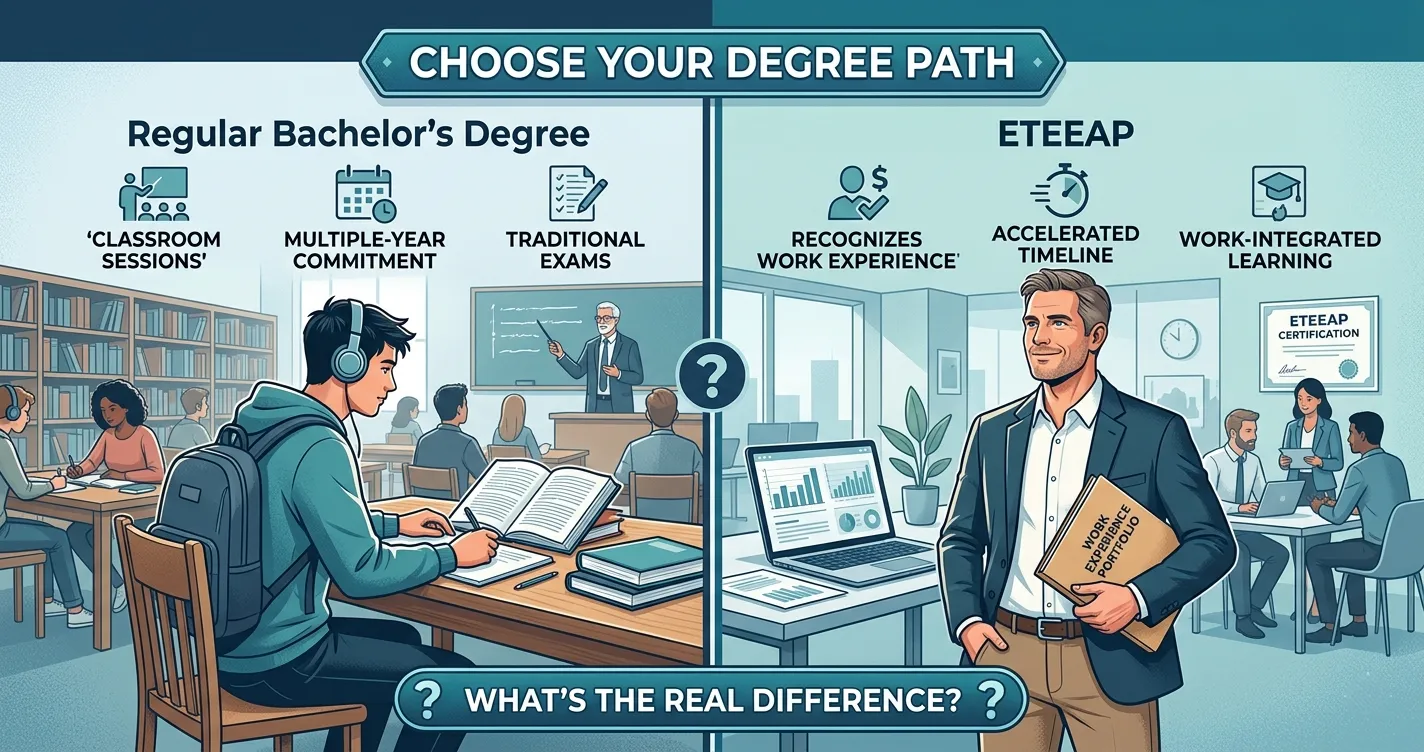
Here is the most important thing to understand before anything else: Open University programs teach you what you need to know. ETEEAP recognizes what you already know.
That is not a small distinction. It is the entire difference.
Open University programs deliver higher education at a distance. You still enroll in subjects. You still complete coursework. You still move through a curriculum semester by semester. The learning just happens online, through modules, or through a blended approach instead of a physical classroom. It is a traditional degree, delivered differently.
ETEEAP does not ask you to retake classes you’ve essentially already lived through. The Expanded Tertiary Education Equivalency and Accreditation Program is a competency-based program that evaluates the knowledge, skills, and expertise you have built over years of actual work experience. If your professional background aligns with the learning outcomes of a degree program, a deputized Higher Education Institution (HEI) can grant you that degree based on a rigorous assessment of your competencies.
Both paths lead to a recognized college degree. The question is which one matches where you are right now.
What Open University Programs Actually Are
Open University programs, also called Open Distance Learning (ODL) programs, are offered by both public and private higher education institutions across the Philippines. The basic idea is accessibility. Instead of requiring students to show up on campus every day, these programs deliver coursework through online platforms, printed modules, recorded lectures, and periodic face-to-face sessions.
The curriculum is the same as the regular program. If you enroll in a Business Administration program through an ODL setup, you’re covering the same subjects as a student in a traditional setup. Marketing management, accounting fundamentals, business law, all of it. You just complete those subjects from wherever you are, at a pace that allows you to stay employed while studying.
This makes Open University programs genuinely useful for people who want structured learning, who are just beginning to build knowledge in a new field, or who may not have enough work experience yet to qualify for a program like ETEEAP.
The flexibility is real. But so is the time commitment. You are still completing a full degree curriculum, subject by subject, unit by unit. The finish line is still three to four years away, sometimes longer if you’re taking a lighter load to manage work at the same time.
What ETEEAP Actually Is
ETEEAP stands for the Expanded Tertiary Education Equivalency and Accreditation Program. It was originally established through Executive Order 330 in 1996 and was recently institutionalized as permanent national law through Republic Act No. 12124, signed in March 2025. That law elevated ETEEAP from a government policy into a fully funded pillar of the Philippine higher education system.
The program operates on a completely different logic from traditional or distance education. Instead of measuring how many hours you spent studying a subject, it measures whether you have actually mastered what that subject teaches. Your work history, professional certifications, TESDA qualifications, on-the-job training, and demonstrated skills are all evaluated by a panel of academic and industry experts at a deputized HEI.
Think of it this way. If you have spent eight years managing a team of engineers, supervising projects, writing technical reports, and solving real operational problems, you have arguably learned more about engineering management than many students do in a lecture hall. ETEEAP is the formal mechanism that allows the Philippine education system to officially recognize that.
The program does include a competency enrichment phase for any gaps identified during your assessment. This means that if your experience covers 85% of a degree’s requirements but is thin on one area, the school will require you to complete specific subjects or modules to bridge that gap. This is what separates ETEEAP from a diploma mill. The degree is earned. It just acknowledges a different kind of earning.
You can read a deeper breakdown of how ETEEAP works including the equivalency and accreditation process, or explore the frequently asked questions for common concerns.
Who Qualifies for ETEEAP
ETEEAP is not available to everyone, and that’s by design. The program is built for professionals with substantial real-world experience, so the entry requirements reflect that.
Under Republic Act No. 12124 and its Implementing Rules and Regulations (CMO No. 11, Series of 2025), a candidate must be a Filipino citizen, at least 23 years old at the time of application, and must have completed secondary education, whether through a high school diploma, the Alternative Learning System (ALS) Accreditation, or the Philippine Educational Placement Test (PEPT). Most importantly, the applicant must have at least five years of aggregate work experience in an industry directly related to the degree program being sought.
That five-year requirement is not just about time served. The IRR specifies that the experience should demonstrate competence in decision-making, planning, and some level of supervisory responsibility. Relevant TESDA certifications and National Certificates are also recognized as supporting evidence of competency.
Overseas Filipino Workers are strongly encouraged to apply. International work experience is valid for ETEEAP assessment, which makes the program a practical option for OFWs who have spent years building specialized skills abroad and now want formal Philippine academic recognition. There’s a dedicated resource for OFWs at ETEEAP.PH worth checking out.
Open University programs generally have fewer restrictive requirements. Most follow standard HEI admission criteria, which typically means finishing senior high school. There’s no minimum age, no minimum work experience, and no need to prove industry proficiency before enrolling. If you’re a fresh graduate who wants a flexible path to a degree, an ODL program would likely accept you. ETEEAP would not, simply because you haven’t met the experience requirement yet.
You can check your eligibility for ETEEAP quickly to see if you currently qualify.
How Each Program Assesses You
This is where the practical experience of each path really diverges.
In an Open University program, you are assessed the same way a regular student is. Quizzes, long exams, projects, research papers, recitations, and final exams. Your grade at the end of each subject reflects how well you performed in that subject during that semester. The system is familiar, predictable, and structured around incremental progress over time.
ETEEAP uses a competency-based assessment model. The deputized HEI convenes a Panel of Assessors made up of internal faculty and external industry practitioners. Together, they evaluate you through several methods. Your professional portfolio is reviewed for documented evidence of your work history and achievements. You may be asked to take a written examination covering the theoretical foundations of your degree program. A practical demonstration might be required depending on your field. And almost universally, you will go through an oral defense or interview where the panel verifies the depth of your expertise and professional judgment.
After that assessment, the panel determines how many units of the degree you’ve already effectively earned through your experience. Any remaining gaps become your enrichment program. The IRR explicitly allows flexible learning modalities for this enrichment phase, including online learning, mobile learning, and blended approaches.
The full assessment process is explained on the ETEEAP program page.
Time to Completion
Open University programs take time. The curriculum is the same as a regular degree program, and even with a lighter per-semester load to accommodate working students, you’re typically looking at three to five years before graduation. Some students take longer. Life happens, semesters get interrupted, and the finish line keeps moving.
ETEEAP works on a different timeline. Because a significant portion of your competencies may already be recognized through the initial assessment, you are only responsible for completing the enrichment program for identified gaps. For some applicants with extensive and well-documented experience, this can significantly compress the overall timeline. For others with more gaps, it takes longer. There’s no universal number, but the program is designed to be completed faster than a full traditional or distance education curriculum.
The important caveat is that ETEEAP is not instant. The application process, document preparation, portfolio building, and panel assessment itself all require real preparation. If you’re serious about it, starting that preparation early makes a significant difference. A practical guide on how to begin your ETEEAP journey is available if you want to understand what the early steps look like.
Cost Comparison
Tuition for Open University programs varies by school and program, but because you’re enrolling semester by semester for multiple years, the total cost over the full duration of the program can be substantial. Add in technology fees, materials, and any required on-campus visits, and it adds up faster than most people expect.
ETEEAP costs are structured differently. You’re paying for an assessment process and then for the specific enrichment subjects you need, rather than for a full curriculum. This means the total financial outlay is generally more concentrated and often lower than completing a full distance education program, though it depends heavily on the deputized school you choose and how many units you need to complete in the enrichment phase.
Exact fees vary widely across institutions. A detailed breakdown of what to expect is covered in the ETEEAP cost guide on ETEEAP.PH, which is worth reading before you start contacting schools.
Is the Degree the Same?
This question matters a lot, so the answer deserves to be stated clearly.
A degree earned through ETEEAP is a legitimate, CHED-recognized bachelor’s degree. It carries the same legal weight as a degree earned through four years of traditional instruction or through an Open University distance learning program. It is issued by the same deputized HEIs that confer degrees to traditional students. The diploma does not say “ETEEAP degree.” It says the degree program you earned, awarded by the institution.
A degree earned through an Open University program is equally recognized. ODL programs offered by CHED-authorized institutions confer the same degree with the same standing.
Neither path produces a lesser credential. Both are fully recognized by employers, government agencies, and professional licensing bodies. ETEEAP graduates are also qualified to sit for applicable licensure examinations, as confirmed by the IRR of RA 12124.
The regular bachelor’s degree vs ETEEAP guide addresses this misconception in more detail if you want to read more on the topic.
Which One Should You Choose?
Honestly, the answer usually becomes clear once you look at your own situation honestly.
Choose an Open University program if you are relatively early in your career and still building foundational knowledge in your field. If you don’t yet meet the five-year work experience requirement for ETEEAP, or if your current experience is in a completely different industry from the degree you want to pursue, a structured distance learning program gives you the curriculum scaffolding to build toward that credential over time. It’s also the right call if you genuinely want to be taught, not just assessed.
Choose ETEEAP if you have already spent years developing deep expertise in your field, and what you’re missing is the formal recognition of what you’ve actually been doing. If your work history is rich and well-documented, if you’ve held supervisory or technical roles, if you’ve completed relevant certifications or training programs along the way, then ETEEAP exists precisely for you. Sitting through four more years of coursework covering material you’ve already mastered in practice isn’t education. It’s bureaucracy.
The program also makes particular sense for OFWs, returning professionals, and anyone who needs a degree not to start learning something new, but to finally get the piece of paper that reflects what they already know.
You can browse the degree programs available through ETEEAP to see if your field is covered, and look through the list of accredited schools to find a deputized institution that might be a good fit.
Both ETEEAP and Open University programs are real, viable, CHED-recognized pathways to a college degree. One teaches you the material at a distance. The other recognizes that you’ve already learned it on the job. The right choice depends entirely on which description fits your life right now.
If you’ve built your career without the diploma to show for it, that experience already has value. ETEEAP is how you make it official.