From Work Experience to World-Class: ETEEAP Graduates Pursuing Master's Degrees Abroad
There’s a moment every ETEEAP graduate remembers. It’s not the panel interview, not the portfolio defense, and honestly, it’s not even the walk across the stage. It’s the quiet realization, weeks or months later, that the diploma in their hands is not a finish line. It’s a passport. And for a growing number of Filipino professionals who earned their bachelor’s degree through the Expanded Tertiary Education Equivalency and Accreditation Program, that passport is now taking them somewhere they never imagined possible: graduate school abroad.
If you’ve ever wondered whether a degree earned through work experience and portfolio assessment could really stand shoulder to shoulder with a traditional diploma when it’s time to apply for a master’s program overseas, this one is for you. We’ll walk through what makes this possible, what the law actually says about it, and what applicants abroad need to know before they hit submit on that graduate school application.
Jump to a section:
- Why This Question Keeps Coming Up
- What the Law Actually Says
- Why Foreign Universities Accept ETEEAP Degrees
- The Real-World Path: From Portfolio to Postgraduate
- What OFWs Should Know Before Applying Abroad
- Common Hurdles and How Graduates Get Around Them
- Never Meant to be a Smaller Version
Why This Question Keeps Coming Up
Every few weeks, someone in an ETEEAP Facebook group asks the same nervous question. Something like, “Pwede ba akong mag-master’s abroad kahit ETEEAP lang ang undergrad ko?” It’s a fair worry. For decades, alternative credentialing carried a quiet stigma, as if a degree earned outside a lecture hall was somehow a lesser version of the real thing.
That stigma is fading fast, and for good reason. ETEEAP was never designed as a shortcut. It’s a rigorous, multi-stage assessment process involving portfolio evaluation, written exams, practical demonstrations, and panel interviews, all measured against the same learning outcomes required of a traditional four-year graduate. Once you understand that, the question shifts. It’s no longer “will they accept my ETEEAP degree,” but rather “how do I present it in a way that shows its full weight.”
What the Law Actually Says
This is where a lot of the confusion clears up once you look at the actual legal text. Republic Act No. 12124, the law that institutionalized ETEEAP, states plainly that the program exists to award degrees to individuals through equivalency, accreditation, validation, and recognition of prior learning, drawing from formal, non-formal, and informal training alongside relevant work experience. The degree conferred through this process is not a certificate of completion or a special credential category. It is the same academic degree a deputized higher education institution would grant to any of its regular students.
That distinction matters enormously when you’re filling out a graduate school application abroad. Your transcript won’t say “ETEEAP.” It will say Bachelor of Science or Bachelor of Arts, issued by a CHED-recognized university, the same as any other graduate of that school.
The law also anticipates further academic progression. Under Section 4 of RA 12124, a bachelor’s degree holder may even apply for equivalency and accreditation toward a second bachelor’s degree, provided the prior learning is related to the new degree being sought. While this particular provision addresses a second undergraduate degree rather than a master’s, it reflects the same underlying principle that runs through the entire law: recognized prior learning keeps counting, program after program, degree after degree. The Implementing Rules and Regulations under CHED Memorandum Order No. 11, Series of 2025, reinforce this by confirming that graduates of ETEEAP programs are qualified to take the appropriate licensure examination unless a specific law says otherwise for that profession, which is itself a strong signal of how the government treats these degrees: as fully valid credentials with no asterisks attached.
Why Foreign Universities Accept ETEEAP Degrees
Universities abroad, particularly graduate admissions offices, generally care about three things when they review an undergraduate transcript: is the issuing institution accredited by a recognized national authority, does the degree meet a minimum credit and competency threshold, and can the applicant demonstrate readiness for graduate-level work.
An ETEEAP degree checks all three boxes. The issuing HEI must be a CHED-deputized institution, often a Center of Excellence or Center of Development in that field, or a state university that has met strict quality benchmarks. The credit load and learning outcomes are mapped against the same Policies, Standards, and Guidelines that govern every regular degree program in that discipline. And frankly, the professional maturity that got someone through ETEEAP in the first place, years of decision-making, supervisory responsibility, and hands-on industry work, tends to translate beautifully into the kind of independent, self-directed thinking graduate programs are looking for.
Some ETEEAP graduates even find their work experience becomes a selling point rather than something to explain away. A returning OFW engineer applying to a master’s program in project management abroad, for instance, often walks in with more real-world case studies than a 22-year-old fresh graduate could ever have.
If you’re still building your case for the CHED-recognized value of your degree, our guide on Regular Bachelor’s Degree vs ETEEAP: What’s the Real Difference? breaks down exactly how the two credentials compare on paper, which is often the first thing an admissions officer or evaluator wants to understand.
The Real-World Path: From Portfolio to Postgraduate
So what does this actually look like in practice? Most ETEEAP graduates who go on to pursue a master’s abroad follow a fairly consistent pattern, even if the destination country and discipline vary wildly.
It usually starts with credential evaluation. Many countries, particularly the United States, Canada, Australia, and several in Europe, require an independent credential evaluation service to assess a foreign bachelor’s degree before a university will even consider the application. These agencies don’t care how the degree was earned domestically. They care whether the issuing institution is recognized by the relevant national authority, which in the Philippines is CHED. Since ETEEAP degrees are issued by the same deputized HEIs and carry the same CHED recognition as any other bachelor’s degree, they typically pass this evaluation without extra scrutiny once the applicant provides the standard Transcript of Records and diploma.
From there, it’s the usual graduate school gauntlet: statement of purpose, recommendation letters, and in many cases, standardized tests like IELTS or the GRE depending on the program. This is actually where ETEEAP graduates often shine, because their statement of purpose isn’t a hypothetical account of what they hope to learn someday. It’s a documented history of what they’ve already built, led, or fixed in the real world.
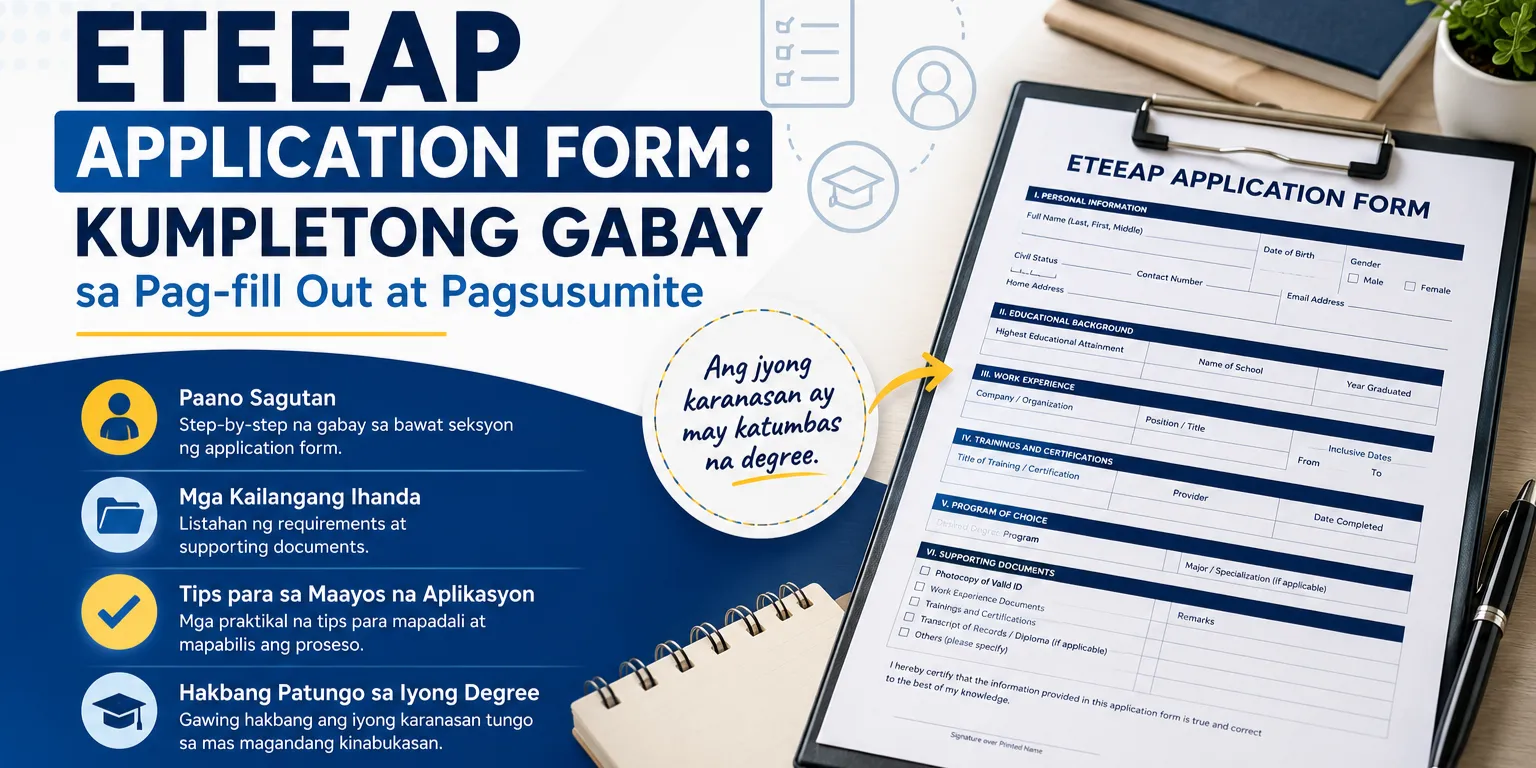
If you’re only starting your ETEEAP journey and graduate school abroad is already on your radar, it helps to choose your undergraduate program with that future goal in mind. Our guide on Paano Piliin ang Tamang ETEEAP Program para sa Iyong Career walks through how to match your current work experience and long-term goals to the right degree track from the start.
What OFWs Should Know Before Applying Abroad
A large share of ETEEAP graduates are, unsurprisingly, current or former Overseas Filipino Workers. Many of them are already living and working in the very countries where they eventually want to pursue a master’s degree, which offers a genuine advantage. They know the culture, sometimes they’ve already built professional networks there, and applying to a local university doesn’t require the same leap of faith as someone applying cold from Manila.
RA 12124 makes clear that Filipino citizens residing abroad are just as eligible for ETEEAP as those living in the Philippines, and the ENROLL OFWs registration system was built specifically to let overseas applicants complete the entire equivalency and accreditation process without needing to fly home. That same flexibility tends to carry forward into how these graduates approach postgraduate study, applying, interviewing, and even enrolling in graduate programs without ever needing to interrupt their current job or relocate mid-process.
For OFWs weighing this path, our dedicated page on ETEEAP for Overseas Filipino Workers (OFWs) covers the full registration process, required documents, and how overseas work experience gets credited, which is the exact foundation you’ll want solid before shifting focus to graduate applications.
Common Hurdles and How Graduates Get Around Them
None of this means the road is completely smooth. A few recurring challenges come up often enough that they’re worth addressing honestly.
The first is document authentication. Foreign universities and credential evaluators often want apostilled or authenticated copies of the diploma and transcript, and delays here are common simply because of processing times at Philippine government offices, not because of anything unique to ETEEAP. Planning several months ahead of any application deadline saves a tremendous amount of stress.
The second is explaining the ETEEAP process itself when it does come up, whether in a statement of purpose or an interview. Some graduates worry they need to downplay how they earned their degree. The opposite is usually true. Being upfront about completing a rigorous, government-mandated competency assessment process, one that required demonstrating mastery through written exams, practical demonstrations, and panel review, tends to impress rather than raise eyebrows. It shows discipline, and graduate admissions committees respect discipline.
The third hurdle is more personal than administrative: confidence. After years of feeling like the missing diploma was holding them back, some ETEEAP graduates carry a lingering hesitation into their next big application, wondering if they’ve truly “caught up.” If that sounds familiar, it might help to read how other graduates pushed through the same doubt. Our collection of Success Stories features professionals, from returning workers to public figures, who walked the exact same path and came out the other side with a degree that opened real doors.
Never Meant to be a Smaller Version
An ETEEAP degree was never meant to be a smaller version of a college education. It’s the same degree, awarded through a different, and arguably harder, route. For the growing number of graduates now setting their sights on graduate school abroad, that distinction is proving to matter less and less to the universities reviewing their applications, and more and more to their own sense of what’s possible next.
If you’re still early in your journey and postgraduate study abroad is already part of your long-term plan, start by making sure your current application is airtight. Explore our ETEEAP Guides for step-by-step walkthroughs on documents, assessments, and program selection, or browse our list of CHED-Accredited Schools to find an institution whose program aligns with where you eventually want to go, degree and all.