ETEEAP Questions Answered: What Filipino Professionals Are Really Asking
If you have been spending time in online communities asking around about the Expanded Tertiary Education Equivalency and Accreditation Program, you already know how many questions swirl around it. There is a lot of curiosity, a lot of anxiety, and honestly, a lot of misinformation mixed in with the helpful advice.
We gathered the most common questions Filipino professionals are raising right now and answered each one based on the official provisions of Republic Act No. 12124, also known as the ETEEAP Act, and CHED’s implementing guidelines. Whether you are just starting to explore the program or are already preparing your documents, this guide is for you.
Questions in this guide:
- Does ALL My Work Experience Count Toward the 5-Year Requirement?
- Can I Count Non-Traditional Experience, Like Church Ministry or Volunteer Work?
- What If My Work Experience is Not Perfectly Aligned With the Degree I Want?
- Can I Apply for ETEEAP While Living Abroad?
- What Does the ETEEAP Assessment Actually Look Like?
- How Do I Choose the Right School?
- Can I Pursue Two ETEEAP Programs at the Same Time?
- What About Previous College Units?
- Is an ETEEAP Degree Valid for Board Exams or Employment Abroad?
Does ALL My Work Experience Count Toward the 5-Year Requirement?
This is probably the single most common concern among applicants. People worry that their work history is too mixed, too “unrelated,” or too informal to qualify.
Here is the official answer: the five-year work experience requirement is cumulative and aggregate. This means it does not have to be continuous, and it does not have to come from a single employer. Under RA 12124, what matters is that the total adds up to at least five years of experience in an industry related to the academic degree you are pursuing.
So if you worked two years in one company, took a short break, and then spent four more years in a related role, your aggregate relevant experience can absolutely qualify you. What the deputized HEI will scrutinize is the relevance of each role to the degree program you are applying for, not whether you stayed at one job the entire time.
A more nuanced question is what counts as “related.” If you are applying for a Business Administration degree, early work experience in a fast-food chain can count, particularly if you held responsibilities in operations, inventory, scheduling, or cash handling. The assessors want to see that you were exposed to functions relevant to the discipline, not just that you worked somewhere in the general industry.
The short answer: document everything, and let the HEI’s panel of assessors make the determination. Do not disqualify yourself before applying.
Can I Count Non-Traditional Experience, Like Church Ministry or Volunteer Work?
This is a genuinely interesting question, and the honest answer is: it depends on the degree and on the HEI.
RA 12124 is clear that ETEEAP recognizes learning from formal, non-formal, and informal sources. The law explicitly includes non-profit and volunteer work as potential evidence of learning and experience. Leadership roles in church ministry, community organizing, or civic service can demonstrate competencies in management, planning, public communication, and coordination, which are all relevant to degrees like Public Administration, Social Work, or even Business Administration.
However, the key is how you document and present that experience. You need to make a clear argument for how your specific responsibilities map to the competencies of the degree you are pursuing. A well-structured portfolio that details your decision-making roles, the people you supervised, and the programs you administered goes a long way. Do not just list “church ministry” and expect the panel to fill in the blanks.
That said, some HEIs may have stricter interpretations than others. If a particular school has declined a similar application before, it is worth asking other deputized schools for their policy. You have options.
What If My Work Experience is Not Perfectly Aligned With the Degree I Want?
Many applicants have careers that evolved in directions they did not plan for, and their work history reflects that mix. The ETEEAP process has a built-in solution for this: competency enrichment.
When the HEI’s panel of assessors reviews your portfolio, they identify which competencies you can demonstrate and which ones have gaps relative to the degree curriculum. The gaps are not necessarily disqualifying. Instead, the school prescribes remedial coursework, modular subjects, or research components to bridge those gaps. Only after you complete the enrichment requirements are you awarded the degree.
This is why the program is described as a comprehensive alternative pathway rather than a simple exemption. It is rigorous, but it is also flexible enough to account for imperfect career paths.
Short courses and online certifications with verified certificates can also be submitted as supplementary evidence of learning. These will not replace work experience, but they can strengthen your portfolio and demonstrate initiative.
Can I Apply for ETEEAP While Living Abroad?
Yes. Under RA 12124, Filipino citizens residing both in the Philippines and abroad are explicitly covered by the program. OFWs are among the most encouraged applicants because their international work experience often represents deep, practical expertise.
The challenge for OFWs is usually logistical, particularly around document submission and the assessment process. Many deputized HEIs have developed online and modular processes to accommodate applicants who cannot be physically present. Private autonomous universities tend to have the most streamlined digital workflows for this, while some state universities may still require in-person attendance for certain assessment stages.
If you are abroad, ask your target school directly about their remote assessment options before committing to an application.
What Does the ETEEAP Assessment Actually Look Like?
The assessment is not a single exam you either pass or fail. It is a multi-stage evaluation of your competency, and each HEI may structure it slightly differently within the guidelines set by CHED.
Generally, you can expect the following:
Portfolio Review. This is the foundation of your application. Your portfolio should not be just a collection of certificates. Think of it as a narrative that connects your years of experience to specific academic subjects. Include job descriptions, work samples, proof of leadership responsibilities, and any third-party validation like TESDA National Certificates or industry awards.
Interview with the Panel of Assessors. The panel is typically composed of both academic faculty and industry practitioners. They will ask you to explain your work, demonstrate your knowledge, and justify how your experience is equivalent to classroom learning. Be specific and confident.
Skills Demonstration or Written Examination. Some programs, particularly in technical or engineering-adjacent fields, may require a practical demonstration or a written test to verify that your knowledge meets the standards of the degree curriculum.
Competency Gap Determination. After the assessment, the panel determines what enrichment, if any, you still need to complete before the degree is awarded.
For tips on preparing for your assessment panel, visit the ETEEAP.PH FAQ page which walks through each stage in detail.
How Do I Choose the Right School?
This is one of the most practical questions applicants face, and there is no single right answer. Your choice of HEI should depend on several factors specific to your situation.
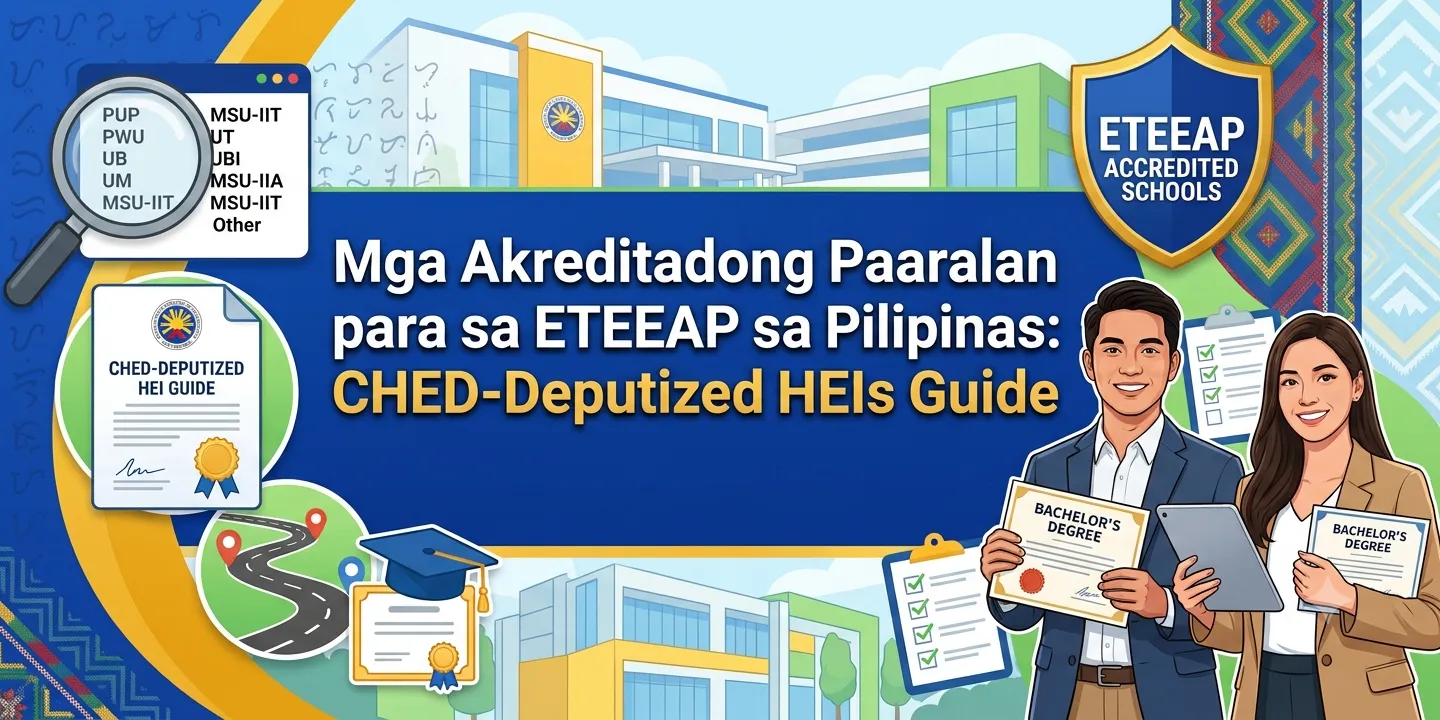
Program Availability. Not all deputized schools offer all degree programs. Start by identifying which schools offer the specific degree you want. The ETEEAP.PH Programs page and Accredited Schools directory are good starting points for mapping this out.
Cost. State universities and colleges are generally more affordable, often significantly so. Private autonomous or deregulated universities tend to charge higher fees but may offer more flexible scheduling and faster processing. Budget for more than just tuition, including assessment fees, research or thesis requirements, and miscellaneous charges. Some applicants have reported total costs running well above 100,000 pesos at certain private schools, so it is worth clarifying the full fee schedule with each institution before enrolling.
Modality. If you are working full-time or are based abroad, a school that offers online or flexible modalities under the Open Distance Learning framework will suit you better than one that requires frequent on-campus attendance.
Reputation in Your Field. A Center of Excellence or Center of Development designation from CHED in your chosen program is a strong indicator of quality. For fields where a PRC licensure exam is the next step after graduation, ask the school whether their ETEEAP graduates in that discipline have successfully sat for and passed the board exams in previous years.
Can I Pursue Two ETEEAP Programs at the Same Time?
This question does not have a universal answer because the policy is ultimately set by each deputized HEI within the broader CHED framework. There is no explicit provision in RA 12124 that prohibits simultaneous enrollment in two ETEEAP programs, but individual schools may have their own rules about this.
In practice, it is worth considering whether it is advisable even if it is allowed. Each ETEEAP journey requires significant documentary preparation, active engagement with assessors, and completion of competency enrichment requirements. Managing two programs simultaneously is a substantial undertaking.
The safest approach is to contact your target schools directly and ask about their policy. If one program is clearly more aligned with your current career, finishing that one first before starting the next is usually the more strategic choice.
What About Previous College Units?
If you attended college previously but did not finish, those units are not lost. The accreditation component of ETEEAP evaluates prior formal learning alongside work experience. If you can submit an official Transcript of Records from your previous school, the HEI’s panel will evaluate those units and credit valid ones toward your degree. This can reduce the number of competency gaps you need to fill during the enrichment phase.
Is an ETEEAP Degree Valid for Board Exams or Employment Abroad?
For PRC licensure examinations in the Philippines, an ETEEAP degree carries the same legal standing as a traditional degree under RA 12124. However, some professional regulatory boards have additional requirements for specific fields. Always verify with your target school whether their ETEEAP graduates in your chosen field have successfully taken the relevant licensure examination.
For recognition abroad, the answer is more complicated and depends heavily on the receiving country’s credential evaluation process and the specific degree. If migration or international credential assessment is your goal, research the requirements of your target country carefully before choosing between ETEEAP and a traditional second degree. Some countries require specific components like practicum or clinical hours that ETEEAP may handle differently from a conventional program.
Your Next Step
The ETEEAP is a serious, government-backed pathway to a CHED-recognized degree, and it is more accessible than many people assume once they understand how it actually works. The key is going in with the right expectations: it requires genuine preparation, honest documentation of your experience, and a willingness to complete any enrichment the school prescribes.
If you are still unsure whether you qualify, check your eligibility and explore the list of accredited schools and programs at ETEEAP.PH.
Ready to take the first step? Visit ETEEAP.PH to check your eligibility and find the right school and program for your career goals. Your years of experience deserve to be recognized.