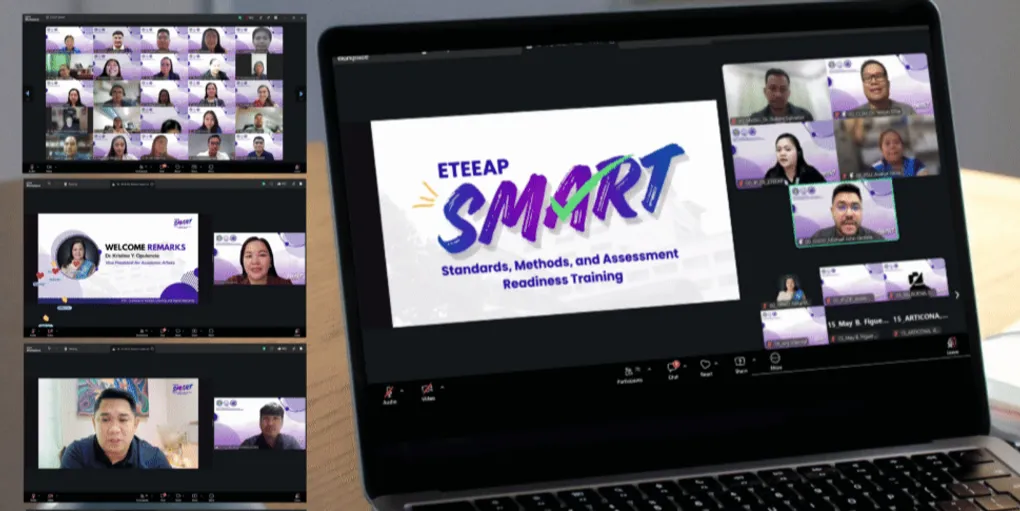
Institute of Flexible Learning and Digital Education (IFLDE) of Rizal Technological University (RTU) Trains Internal Assessors Through Three-Day ETEEAP SMART Program
A college degree earned through ETEEAP only carries weight if the people evaluating it know exactly what they are doing. That is the quiet truth behind every successful application, and it is also the reason a recent training held by Rizal Technological University deserves more attention than a typical internal seminar.
From June 9 to 11, 2026, the Institute of Flexible Learning and Digital Education (IFLDE) of Rizal Technological University (RTU) ran a three-day program over Zoom called the ETEEAP SMART Training, short for Standards, Methods, and Assessment Readiness Training. The participants were not applicants. They were RTU’s own internal assessors, the people who will eventually sit across the table (or the screen) from working professionals hoping to turn years of experience into a recognized degree.
Here is a quick jump to what this article covers:
- What Happened at RTU-IFLDE
- Why Internal Assessors Carry So Much Weight
- What a Training Like SMART Likely Covers
- What This Means If You’re Eyeing an RTU ETEEAP Degree
- Part of a Bigger Push for Quality Nationwide
What Happened at RTU-IFLDE
IFLDE positioned the training as a professional development program meant to strengthen the institution’s ability to implement ETEEAP the right way. Rather than a one-off orientation, it stretched across three full days, which says something about how seriously the university is treating the role of an assessor. According to the program description, the training aimed to give RTU’s internal assessors the knowledge, skills, and ethical grounding needed to conduct assessments that are rigorous, fair, and compliant with CHED’s standards.
That last part, ethical grounding, is worth sitting with for a moment. Assessing someone’s life experience is not the same as grading a multiple-choice exam. There is judgment involved, and judgment can go wrong if the people making it are not properly calibrated.
Why Internal Assessors Carry So Much Weight
Under the law that governs this whole program, internal assessors are not a side detail. They are part of the legal architecture that makes ETEEAP credible in the first place. The Implementing Rules and Regulations of Republic Act No. 12124, the law that institutionalized ETEEAP nationwide, requires every deputized school to constitute a panel of internal and external assessors who determine the appropriate equivalency credits for an applicant’s prior learning and experience.
Internal assessors are defined as competent curriculum or discipline experts working within the institution itself, while external assessors come from industry, bringing a practitioner’s eye to the table. Together, this panel reviews portfolios, conducts interviews, oversees written or practical exams, and ultimately decides how much of a candidate’s life and career maps onto an actual degree program. If you want the full legal picture of how RA 12124 reshaped the program, our breakdown of the law is a good place to start, and so is our explainer on CHED CMO No. 11, Series of 2025: The New ETEEAP Rules Explained, which is the actual implementing rules document this whole assessor structure comes from.
In short, the assessor is the gatekeeper and the bridge at the same time. Get that role wrong, and either qualified people get turned away, or unqualified credits get handed out, both of which damage the credibility of the entire system.
What a Training Like SMART Likely Covers
While IFLDE has not published a detailed session-by-session breakdown publicly, the name of the program tells us a lot on its own. Standards, Methods, and Assessment Readiness lines up closely with what CHED’s own implementing rules require of any institution running ETEEAP. Deputized schools are expected to maintain well-defined competency standards for each degree program, structured assessment procedures that can be either work-based or competency-based, and rubrics that allow assessors to award credit consistently rather than on a hunch.
Training sessions built around those three pillars typically walk assessors through how to read a portfolio without bias, how to run a panel interview that actually tests competency rather than just confirming a resume, and how to document decisions so they can hold up to CHED monitoring later on. If you are curious what that interview experience looks like from the applicant’s side of the table, our guide on the ETEEAP Panel Interview: Common Questions and How to Answer Them gives a useful mirror image of what assessors are trained to listen for.
What This Means If You’re Eyeing an RTU ETEEAP Degree
For anyone considering ETEEAP through RTU, a training investment like this is a genuinely good sign. It suggests the university is not treating its program as a paperwork formality but as a real academic process with real people behind the evaluation. A well-trained panel tends to mean clearer expectations, fairer assessments, and fewer surprises once you sit for your own portfolio review or interview.
Of course, training internal assessors is only one piece of a much larger compliance picture. CHED deputization status, program-specific authority, and ongoing monitoring all factor into whether a school’s ETEEAP pathway is solid. Before applying anywhere, it is worth confirming current deputization status directly with the institution and cross-checking our Accredited ETEEAP Schools Directory. And if you are still not sure whether you even meet the basic requirements to apply, our eligibility checker walks you through the minimum age, education, and work experience criteria in a few minutes.
Part of a Bigger Push for Quality Nationwide
RTU’s training did not happen in a vacuum. The past few months have shown a clear pattern of CHED tightening and expanding the program at the same time. The Commission recently reported that ETEEAP now reaches 114 higher education institutions nationwide, alongside a new online enrollment system and expanded scholarships. At the same time, only a handful of schools have been formally re-deputized after a fresh round of recertification, with several others still working through the process. That tension between growth and quality control is exactly why programs like ETEEAP SMART matter. Expansion without trained assessors would be a hollow win, and CHED appears to know it.
If you want the bigger numerical picture of where the program stands, our piece on ETEEAP by the Numbers: Enrollment and Graduate Trends from 2020 to 2025 lays out just how much the program has grown, and how much is riding on institutions getting the assessment side right.
Whether you are a working professional plotting your own ETEEAP journey or simply keeping tabs on how Philippine higher education is evolving, stories like RTU’s assessor training are worth watching. They are a reminder that behind every degree handed out through prior learning recognition, there is a panel of people who trained hard to make that recognition mean something. Ready to see where you stand? Head over to our eligibility page to check your qualifications, or browse our Guides section for more on how the assessment process actually works.
Photo Credit: Rizal Technological University