CHED and UPOU Open Nominations for ACHIEVE APL: A New Executive Program for ETEEAP Assessors
If you have ever sat across from an ETEEAP panel, or served on one yourself, you already know how much weight those assessors carry. They are the ones who take someone’s years of work experience and translate it into academic credit. That kind of judgment is not something you develop overnight, and it is exactly the gap that CHED and the University of the Philippines Open University are now trying to close.
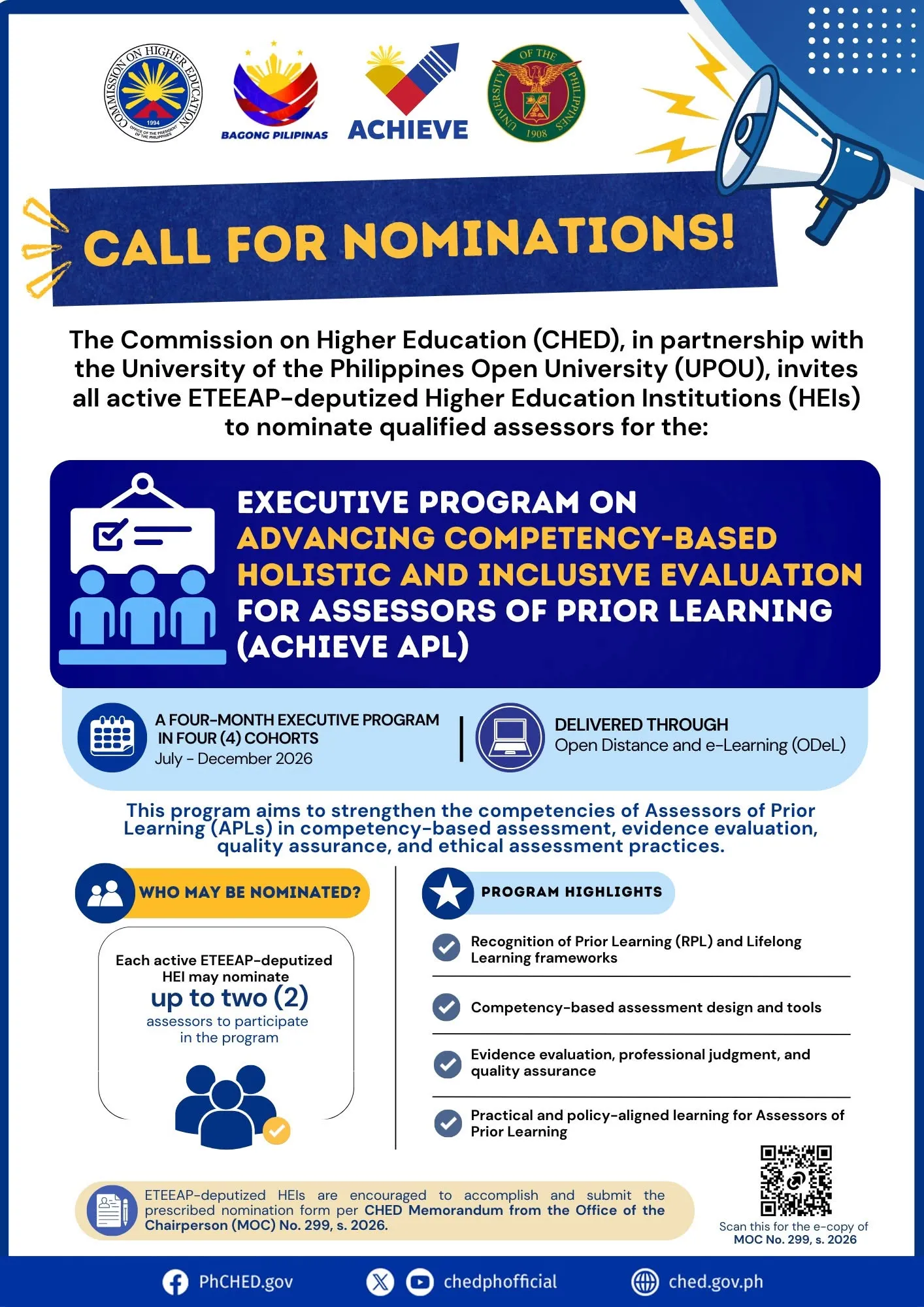
The Commission on Higher Education, working with UPOU, has opened nominations for a new executive training program built specifically for Assessors of Prior Learning. It is called ACHIEVE APL, short for the Executive Program on Advancing Competency-Based Holistic and Inclusive Evaluation for Assessors of Prior Learning, and it is aimed squarely at the people who run ETEEAP evaluations inside deputized schools across the country.
Here is a quick look at what this article covers. Jump ahead if you already know what you are looking for.
- What Is ACHIEVE APL?
- Who Can Be Nominated
- What the Program Will Cover
- Program Format and Schedule
- Deadline and How to Submit a Nomination
- Why This Matters for the ETEEAP System
What Is ACHIEVE APL?
ACHIEVE APL is a four month executive program designed to sharpen how ETEEAP assessors actually do their jobs. It is continuing education for the evaluators, not for the applicants seeking a degree, and that distinction matters. The program zeroes in on competency-based assessment, evidence evaluation, quality assurance, and ethical assessment practices, which together form the backbone of a fair and credible ETEEAP process.
This kind of investment in assessor capacity is not something you see announced every day, and it says a lot about where CHED wants to steer the program next. Under Republic Act No. 12124, deputized HEIs are already required to form panels of internal and external assessors who determine equivalency credits for each candidate. Training those panels properly is not a minor detail. It is often the difference between a rigorous accreditation system and one that just goes through the motions.
Who Can Be Nominated
Participation is intentionally limited. Each active ETEEAP-deputized Higher Education Institution may nominate up to two assessors to take part, and that cap keeps the cohorts manageable while still giving every deputized school a seat at the table.
If your institution currently holds deputized status, chances are you already have a Manual of Operations in place, a designated ETEEAP office, and a working pool of internal and external assessors, since these are baseline requirements for deputization in the first place. ACHIEVE APL builds directly on top of that existing structure rather than asking schools to start from scratch. You can check which institutions currently hold deputized status through our accredited schools directory.
What the Program Will Cover
The curriculum leans heavily on practical, policy-aligned content instead of abstract theory. Recognition of Prior Learning and lifelong learning frameworks form the conceptual foundation, giving assessors a shared understanding of how informal and non-formal learning gets validated academically. From there, the training moves into competency-based assessment design and tools, covering the actual instruments assessors rely on day to day, things like portfolio rubrics, practical demonstrations, and structured interviews.
Evidence evaluation, professional judgment, and quality assurance make up another major thread, and this is arguably the most subjective part of an assessor’s work. Deciding how much weight to give a candidate’s employment history against their training certificates, or against how they perform in an interview, requires calibrated judgment. That kind of calibration improves with structured practice, not guesswork.
The program also folds in practical, policy-aligned learning built specifically around the realities of being an Assessor of Prior Learning. This connects to the broader assessment framework already laid out in the ETEEAP Act, which calls for standards covering written examinations, practical demonstrations, and portfolio assessments as valid ways to measure a candidate’s competence.
Program Format and Schedule
ACHIEVE APL runs across four cohorts between July and December 2026, delivered entirely through Open Distance and e-Learning. UPOU’s involvement makes sense given its long track record with ODeL delivery, and it also means assessors from provinces far from Metro Manila will not have to travel just to take part.
Running the program in cohorts rather than one large batch is a sensible choice too. It gives CHED and UPOU room to refine the training along the way, and it spreads participation out so deputized HEIs are not scrambling to free up staff all at once.
Deadline and How to Submit a Nomination
Nominations are due July 15, 2026. Deputized HEIs are encouraged to complete the prescribed nomination form outlined in CHED Memorandum from the Office of the Chairperson No. 299, series of 2026. The full memorandum is available directly from CHED as a PDF document, which you can access here: MOC No. 299, s. 2026.
Given how tight the window is, ETEEAP offices should not wait until the last week to sort out the paperwork. Internal approvals, gathering assessor credentials, and getting sign-off from the right office within the institution all take time, and with only two seats per school, those spots will likely fill up fast once word gets around.
Why This Matters for the ETEEAP System
It is easy to focus on the applicant side of ETEEAP, since that is where most of the personal stories come from. But the strength of the whole program ultimately rests on the quality of its assessors. A poorly trained panel can shortchange a qualified candidate, or worse, wave through someone who has not truly demonstrated the competencies required. Neither outcome serves the public trust that ETEEAP depends on to function.
Programs like ACHIEVE APL signal that CHED is starting to treat assessor quality with the same seriousness it applies to candidate qualifications. It also fits a pattern we have been following closely, from the steady expansion of deputized institutions to CHED’s recognition of standout ETEEAP providers, all pointing toward a program that is scaling up while trying to keep its standards intact.
If your institution is currently deputized to offer ETEEAP, this is worth acting on now rather than later. Talk to your program coordinator, review MOC No. 299, and get your nomination form submitted before July 15. For more updates on ETEEAP policy changes, provider announcements, and application guides, keep an eye on our news and updates page.