Tuning In to a New Future: CHED Region 3 Promotes ETEEAP on RWFM 95.1 and CLTV 36
For many working Filipinos in Central Luzon, the idea of going back to school feels like a door that quietly closed years ago. Long hours, family responsibilities, and the cost of traditional schooling keep that door shut. But CHED Regional Office 3 is actively working to open it back up, and they are doing it one broadcast at a time.
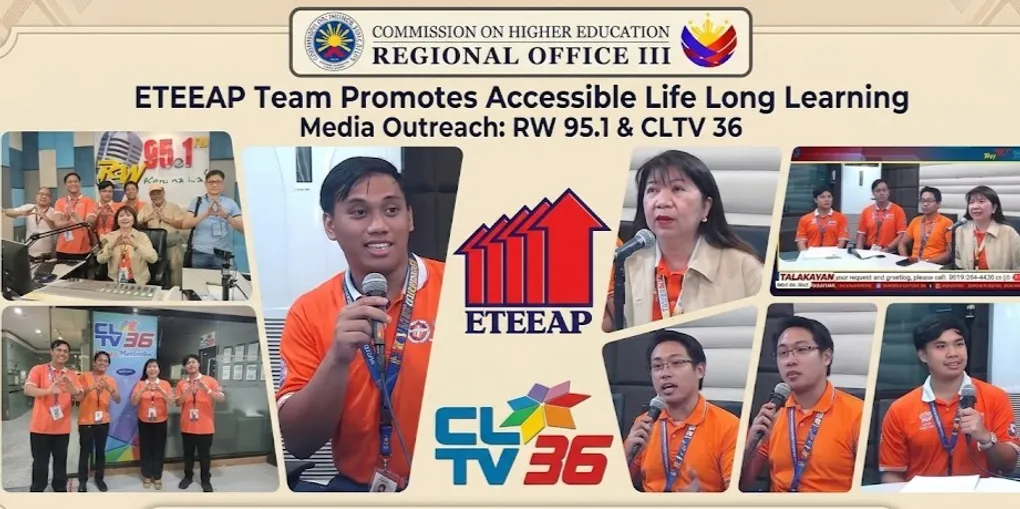
In a recent appearance on the TALAKAYAN program on RWFM 95.1, streamed simultaneously over CLTV 36, the CHED RO3 ETEEAP Team took their message directly into the homes and ears of Central Luzon residents. The topic: the Expanded Tertiary Education Equivalency and Accreditation Program, and how it can transform the professional lives of people who have spent years building expertise outside the classroom.
In This Article
- What is TALAKAYAN and Why Did CHED RO3 Go on Air?
- The ACHIEVE Agenda: Making Lifelong Learning a Priority
- What the ETEEAP Team Shared on Air
- Viewers Called In, and the Team Answered
- Who Can Apply for ETEEAP?
- What Happens After You Apply?
- Your Next Step Starts Here
What is TALAKAYAN and Why Did CHED RO3 Go on Air?
TALAKAYAN, which means “dialogue” or “open discussion” in Filipino, is a public affairs program broadcast on RWFM 95.1 and streamed through CLTV 36, both serving the Central Luzon area. The format encourages candid conversations about issues that matter to everyday Filipinos, and CHED RO3’s decision to use this platform was a deliberate and strategic one.
Not every working professional in the region has consistent internet access or the habit of browsing government websites. But millions of Filipinos still listen to the radio during commutes, lunch breaks, or while working. A broadcast appearance reaches people where they already are, rather than expecting them to seek out information on their own.
By bringing the ETEEAP conversation to TALAKAYAN, CHED RO3 was doing something simple but powerful: removing one of the most common barriers to applying for the program, which is simply not knowing it exists.
The ACHIEVE Agenda: Making Lifelong Learning a Priority
The broadcast was not a one-off initiative. It is part of CHED’s broader ACHIEVE Agenda, a framework guiding how the Commission approaches its mission across all its regional offices. The “A” in ACHIEVE stands for Advanced and Accessible Lifelong Learning, and the ETEEAP is one of the central programs under this commitment.
The idea behind this pillar is straightforward: education should not stop at graduation, and it should not be exclusive to those who had the opportunity to study continuously from elementary school through college. A skilled technician who has spent fifteen years in manufacturing deserves a path to a degree just as much as a fresh high school graduate heading to university.
CHED’s push to use broadcast media for ETEEAP promotion is a direct expression of this commitment. Reaching communities through platforms they already trust and use is how the agenda moves from policy to practice.
What the ETEEAP Team Shared on Air
During the TALAKAYAN segment, the CHED RO3 ETEEAP Team discussed the advantages and flexibility of the program, two qualities that set ETEEAP apart from conventional college enrollment.
Here is what makes ETEEAP genuinely different:
Recognition of real-world learning. ETEEAP does not treat years of professional work as irrelevant to academic credentials. Under Republic Act No. 12124, also known as the ETEEAP Act of 2025, prior learning from formal, non-formal, and informal sources can be identified, assessed, and assigned equivalent academic credits. That means the skills you have already developed on the job are not starting from zero.
No need to sit in a traditional classroom. Deputized higher education institutions use competency-based evaluations, including written tests, portfolio assessments, practical demonstrations, and panel interviews. The program is designed around what you know and can do, not how many hours you have spent in a lecture hall.
Open to a wide range of learners. ETEEAP is available to high school graduates, senior high school graduates, technical-vocational graduates, college undergraduates who stopped before finishing, and even existing degree holders who want to pursue a second undergraduate degree in a related field.
Financial assistance is available. Under RA 12124, ETEEAP learners may access student financial assistance programs under Republic Act No. 10931, otherwise known as the Universal Access to Quality Tertiary Education Act. This means cost does not have to be a permanent obstacle for qualified applicants.
Viewers Called In, and the Team Answered
One of the most valuable parts of the TALAKAYAN appearance was the open phone-in portion, where viewers and listeners submitted their questions directly to the ETEEAP Team. The team took time to address each query, offering practical guidance on the program in plain language.
This kind of real-time engagement matters. When people hear answers to the exact questions they have been carrying around, it shifts ETEEAP from an abstract government program into something they can actually picture themselves doing. It is also a sign that the people running ETEEAP outreach in Region 3 understand the concerns of their audience.
Common questions from working professionals tend to revolve around eligibility, the documents needed to apply, how long the process takes, and whether the resulting degree is genuinely recognized. These are reasonable concerns, and addressing them openly on a public platform builds the kind of trust that turns awareness into action.
Who Can Apply for ETEEAP?
If the TALAKAYAN broadcast sparked your interest, here is a quick summary of the basic qualifications. These are the minimum criteria under both the original program guidelines and the updated provisions of RA 12124.
You may qualify for ETEEAP if you meet all of the following:
- You are a Filipino citizen. The program is open to Filipinos residing in the Philippines or abroad.
- You are at least 23 years old. A birth certificate is required to confirm this.
- You completed secondary school. A high school diploma or its equivalent, such as a PEPT placement result qualifying you for college, satisfies this requirement.
- You have at least five years of aggregate work experience in an industry related to the degree program you are applying for. This experience does not have to be continuous, but it must be relevant and documented.
- You can demonstrate proficiency in your discipline. This can be shown through a certificate of proficiency from an employer, a government regulatory body, TESDA, or through a business registration if you are self-employed.
Deputized HEIs may also set additional criteria on top of these, so it is worth contacting your chosen school directly to confirm their specific requirements.
Not sure if you qualify? Visit Eligibility Checker for a simple eligibility check guide.
What Happens After You Apply?
Once you submit your application to a deputized higher education institution, the assessment process begins. A Panel of Assessors, made up of academic faculty and industry experts, will evaluate your knowledge, skills, attitudes, and values relevant to your chosen degree program. This is done through a combination of portfolio review, written and practical examinations, and a panel interview.
Based on the results, the school will assign equivalency credits for what you already know. Any gaps between your demonstrated competencies and the full degree requirements may be addressed through competency enrichment modules or supplemental academic coursework. Once all requirements are met, you graduate with a degree that carries the same legal standing as a traditional four-year diploma.
You can explore available degree programs and get a clearer picture of what the journey looks like on the ETEEAP.PH website.
Your Next Step Starts Here
The CHED RO3 ETEEAP Team’s appearance on TALAKAYAN is a reminder that the program is active, supported, and increasingly visible across the Philippines. Outreach through trusted local media channels like RWFM 95.1 and CLTV 36 is how CHED turns a national policy into a real opportunity for the working Filipinos of Central Luzon.
If you have spent years building your skills and expertise in your field, your experience already has real academic value. The ETEEAP exists to recognize that.
Ready to explore your options? Start by learning more about what ETEEAP is and how it works, browse the list of accredited schools accepting applications, or read through the frequently asked questions to get answers to the most common concerns.
Your degree is closer than you think. Take the first step at eteeap.ph.
Credits to: CHED Regional Office III https://www.facebook.com/CHEDRegionalOffice3