CHED and DMW Hold Online Orientation on Non-Conventional Higher Education for OFWs: A Recap
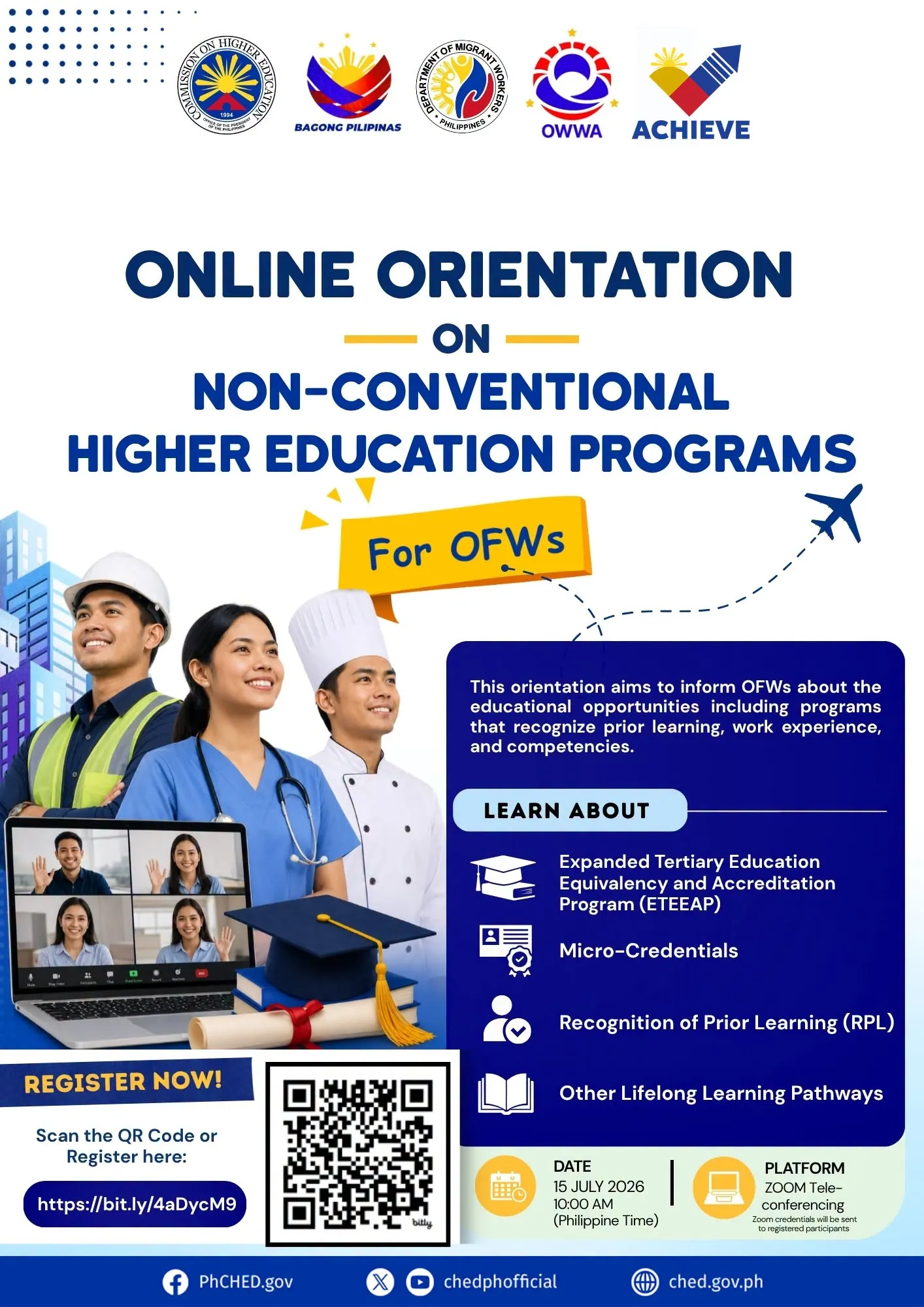
Two days ago, on July 15, 2026, a good number of Overseas Filipino Workers logged into a Zoom call at 10 in the morning, Philippine time, on what was probably their break, their commute, or their off-shift hours somewhere on the other side of the world. They were there for the Online Orientation on Non-Conventional Higher Education Programs for OFWs, a joint undertaking of the Commission on Higher Education (CHED) and the Department of Migrant Workers (DMW). The pitch was simple: you do not need to sit in a classroom for four years to earn a college degree, and there is more than one road that gets you there.
If you missed the live session, or if you attended but want the bigger picture behind everything that was mentioned, this recap walks through the four pathways the orientation covered and what each one actually means for someone who has spent years working abroad.
In This Article
- What the Orientation Was About
- ETEEAP: Turning Years Abroad Into a Degree
- Micro-Credentials: Recognition in Smaller Pieces
- Recognition of Prior Learning: The Idea That Ties It All Together
- Other Lifelong Learning Pathways Worth Knowing
- Why a CHED and DMW Partnership Makes Sense
- What to Do Next
What the Orientation Was About
The session was framed around a question that a lot of OFWs quietly carry with them: what happens to all the skill and judgment built up over years of work abroad if there is no diploma attached to it? CHED and DMW used the orientation to introduce four pathways that answer that question in different ways: the Expanded Tertiary Education Equivalency and Accreditation Program, micro-credentials, Recognition of Prior Learning, and a handful of other lifelong learning routes that fall outside the traditional four-year mold.
None of these programs are brand new inventions cooked up for the orientation. They already exist under Philippine law and CHED policy. What the session did was put them side by side, in plain language, so that OFWs could see which one actually fits their situation, since these programs are often explained in isolation and rarely compared against each other in one sitting.
ETEEAP: Turning Years Abroad Into a Degree
Of the four, ETEEAP is the one with the longest track record and the clearest legal footing. It started under Executive Order No. 330 back in 1996, and in March 2025 it graduated from an executive order into a full law when President Ferdinand Romualdez Marcos Jr. signed Republic Act No. 12124, the ETEEAP Act. That law gave the program a permanent budget line, a technical secretariat inside CHED, and clearer standards for how schools get authorized to run it.
The mechanics are straightforward once you see them laid out. An applicant needs to be a Filipino citizen, at least 23 years old, a high school graduate or PEPT or ALS passer, and someone with at least five aggregate years of work experience related to the degree they want. A panel of internal and external assessors then evaluates that experience through portfolio review, written exams, practical demonstrations, and an interview, and maps it against the learning outcomes of an actual degree program. Whatever gaps remain get filled through a shorter competency enrichment phase rather than a full four-year curriculum, which is why many ETEEAP candidates finish in one to two years.
For OFWs specifically, this experience does not have to be earned inside the Philippines. Work abroad counts, provided it is genuinely connected to the degree being pursued, and CHED already runs a dedicated online entry point for this called ENROLL OFWs. You can read the full breakdown of that portal in our earlier piece on CHED’s ENROLL OFWs registration system, and get a complete rundown of qualifications and required documents on our ETEEAP for OFWs guide.
Micro-Credentials: Recognition in Smaller Pieces
Micro-credentials work on a different scale than a full degree. Instead of mapping years of experience against an entire curriculum, a micro-credential recognizes a specific, narrower skill set, something closer to a single competency or a cluster of related ones rather than a whole discipline. Under CHED’s rules for ETEEAP implementation, schools that want to issue micro-credential certificates as part of their program still need prior approval from the Commission, which keeps these certificates tied to actual national standards rather than being handed out loosely.
For an OFW, the appeal is speed and specificity. Not everyone is ready to commit to a full degree assessment right away, and not everyone needs to. A micro-credential can formally document a specific technical skill, a supervisory competency, or a certification you already hold, giving you something concrete to show employers now while you decide whether to pursue the bigger equivalency process later. In many cases, these smaller credentials can also stack toward a larger qualification down the line.
Recognition of Prior Learning: The Idea That Ties It All Together
Recognition of Prior Learning, or RPL, is less a single program and more the underlying principle that makes ETEEAP, micro-credentials, and similar pathways possible in the first place. It is the formal process of identifying, assessing, and validating learning that happened outside a classroom, whether that learning came from years on the job, informal training, community involvement, or simply life experience accumulated while supporting a family abroad.
CHED’s implementing rules for RA 12124 actually use the term RPL directly when discussing how special graduate programs and similar pathways are recognized, which tells you it is not a side concept. It is the legal and academic basis for everything else discussed at the orientation. ETEEAP is, in effect, the Philippines’ most developed application of RPL for undergraduate and select graduate degrees, while micro-credentials apply the same logic at a smaller scale. Understanding RPL as the umbrella term helps explain why these programs share so much of the same DNA, from the emphasis on portfolios and assessment panels to the insistence that experience has to be evaluated against real academic standards, not simply taken at face value.
Other Lifelong Learning Pathways Worth Knowing
Beyond ETEEAP, micro-credentials, and RPL, the orientation also touched on a broader set of flexible learning routes that OFWs can tap into depending on their circumstances. These include programs delivered through Open Distance Learning and e-Learning arrangements, which let schools offer instruction and assessment fully online under a separate CHED authority, and Transnational Higher Education arrangements, which govern how foreign and local institutions can jointly deliver programs to Filipinos here and abroad.
The common thread across all of these pathways, ETEEAP included, is flexibility of time and place. None of them require an OFW to give up their job overseas or fly home mid-contract just to attend class. Whether the format is a fully online degree completion program, a blended learning module, or a portfolio-based assessment conducted over video call, the design intent is the same: recognize that adult learners with full-time jobs and families need a different kind of academic runway than an eighteen-year-old freshman does.
Why a CHED and DMW Partnership Makes Sense
Pairing CHED with DMW for this kind of orientation is not a random combination. DMW was created under Republic Act No. 11641 in 2022, absorbing the functions of the former Philippine Overseas Employment Administration and other OFW-focused offices that used to be scattered across different departments. Its mandate covers the full arc of an OFW’s journey, from deployment to protection while abroad to reintegration once they come home, and education has become an increasingly central part of that reintegration conversation.
CHED, meanwhile, holds the academic authority to actually grant equivalency credits and degrees. Neither agency can do the full job alone. DMW has the reach into OFW communities and the reintegration mandate, while CHED has the accreditation framework and the network of deputized schools. An orientation like this one is really a handshake between an agency that knows where OFWs are and what they need, and an agency that controls the pathway to a recognized diploma. It also builds on other recent collaborations in this space, including the LEAP-OFWs scholarship program launched earlier this year between CHED and the Overseas Workers Welfare Administration, which funds ETEEAP applicants through a pilot batch of 100 slots.
What to Do Next
If the orientation convinced you that one of these pathways fits your situation, ETEEAP is the most well-established place to start, since it has the clearest legal framework, the longest list of participating schools, and the most complete public documentation. Begin by checking whether you meet the basic requirements on our eligibility guide, and use the quick qualification checker to see where you stand before you commit time to gathering documents.
From there, browse the list of CHED-deputized schools and the available degree programs to find an institution whose offerings actually match your field of work. Our OFW-specific guide breaks down the full document checklist and answers the questions overseas applicants ask most often, and our news and updates section is where we will post details as CHED and DMW release information on any follow-up sessions, application windows, or expanded pilot batches connected to this orientation.
Years of work abroad already taught you more than most people realize. Sessions like this one exist to make sure that experience finally has a diploma to match it. Start by checking your eligibility on ETEEAP.PH, and take the first real step toward the degree you have already earned through the work you have done.